

Our Offbeat Life contains affiliate links & participates in the Amazon Services LLC Associates Program & other affiliate programs. If you buy something using an Amazon or other link, we may receive a commission at no extra cost to you. See our Disclosure for more details.
Villa Vanilla Costa Rica: Our Spice Farm Day Trip

This post was written in collaboration with Villa Vanilla Costa Rica.
Considering a day trip to Villa Vanilla Costa Rica? You’ve come to the right place!
My family spent three months in Costa Rica, and visited Villa Vanilla during our time in Manuel Antonio. I’ve got the scoop on everything you need to know!
Costa Rica is teeming with diverse activities to please everyone, from hiking and hanging bridges to exploring local beaches and spotting wildlife.
In Manuel Antonio especially, there are so many options it can be hard to choose one!
If you’re looking for something a little different than the usual suspects, though, I recommend the Villa Vanilla Costa Rica spice farm tour.
It’s low-key yet still interactive. Little Man loved that the whole tour was about participants seeing, touching, and tasting the various spices that grow on the farm.
Villa Vanilla Costa Rica Tour Overview
Villa Vanilla is a 155-acre (63 hectare) farm located about 30-minutes outside the popular tourist areas of Quepos and Manuel Antonio. It’s also an hour from Uvita.
It’s quite different from the beach towns in terms of both scenery and pace of life. If you take a drive out here, you’ll get to see how everyday Costa Ricans live in the countryside.
The town has a small school, church, a couple of basic supermarkets, and very friendly locals.
If you don’t want to drive yourself over there, as we did, you can also arrange for round-trip transportation from your hotel or vacation rental in Manuel Antonio or Quepos.

Operating Hours
The Villa Vanilla Costa Rica spice farm offers guided walking tours twice a day, Monday through Friday at 9:00 am and 1:00 pm.
On Saturdays, the only tour is available at 9:00 am. The farm is closed on Sundays.
Tour reservations are essential, but you are free to visit the gift shop and buy spices any time during business hours.
Tour Costs
Without Transportation
Adults: $45 per person
Children 5-12: $25 per person
Children Under 5: Free
With Round Trip Transportation from Quepos/Manuel Antonio
Adults: $55 per person
Children 5-12: $40 Per Person
Children Under 5: Free
Note: For both with and without transportation options, you have an option to pay $5 to allow children under 5 to take part in the taste test. I do recommend doing this!
Other Tour Details
The tour lasts about two hours. We were done with our 9 am tour by about 11 am, so they do stay on the time target pretty well.
Although the trail itself is fairly flat, the walking bridge to the lookout point is rather narrow. And there are only stairs leading up to the lookout point for the tasting portion of the tour.
I would not consider this tour to be accessible for people in wheelchairs or who need assistance walking.

Touring Villa Vanilla Costa Rica Spice Farm
Their tour is all hands-on, and it appeals to people of all ages.
You’ll use all five senses to explore the farm while identifying a fascinating variety of spices including vanilla, true Ceylon cinnamon, cacao, black pepper, allspice, turmeric, and various exotic fruits and medicinal herbs.
Introduction
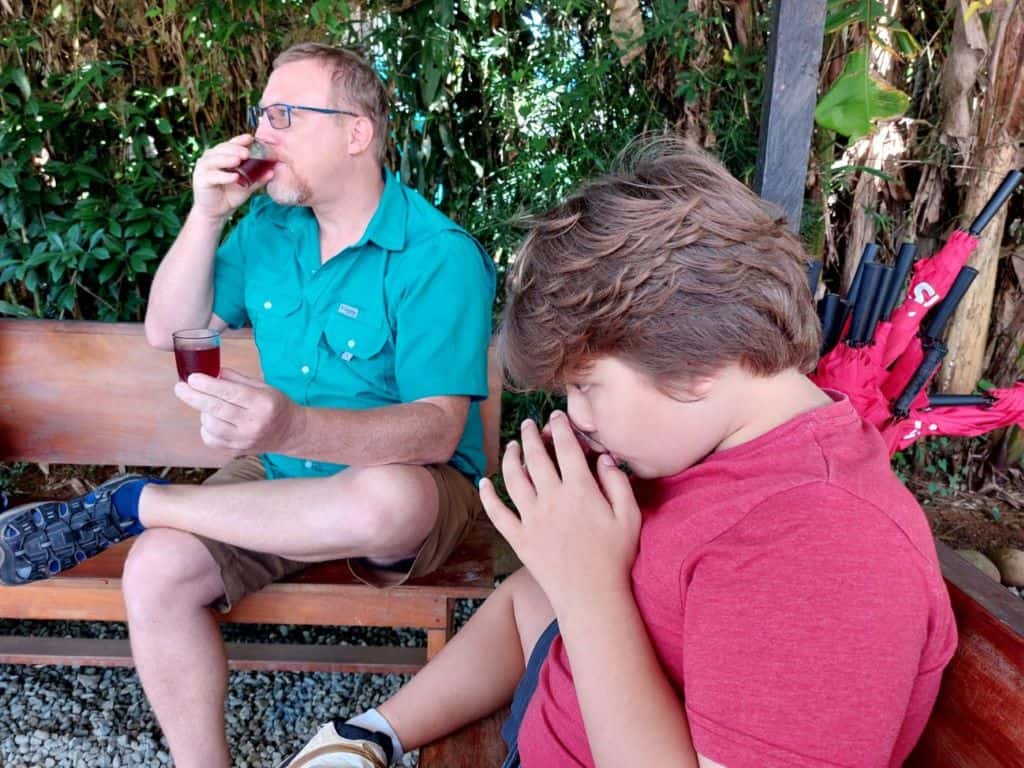
On arrival at Villa Vanilla Costa Rica, you start out sitting under a shaded outdoor canopy. We sat on wooden benches while the tour guide, Joyce, told us a bit about the farm’s history.
The interactive aspect of the tour started immediately, with a fragrant and flavorful welcome drink.
Little Man is hit-or-miss with drinking teas, but after a moment of apprehension, he drank all of this and even tried to steal mine to drink that as well!
Chocolate
Also at the welcome area, Joyce taught us about the growing and harvesting process of cacao which is made into chocolate. She opened a huge cacao ‘berry’ and had each of us try the seeds inside.
First, you suck on the outer white pulp which is soft and gummy. I was surprised at how sweet it is. Even Little Main said he liked it.
She passed around cacao nibs for people to try, and he said those weren’t very good. I didn’t mind them, though.
Pro Tip: Mosquitos help pollinate cacao so you need to hate them just a little bit less.
When she told us to chew the insides bean, though, he said it was the grossest chocolate ever. Of course, since it wasn’t sweetened with anything.
Raw cacao is pretty bitter. It was a fun learning experience!

Spice Trail
The spice trail walk begins at the farm’s compost area, where Joyce explained the various ways that Villa Vanilla Costa Rica uses as many of the plant parts as possible to minimize waste and make the spice farm more sustainable.
The compost area is also right before the entrance to the distinctive “Epiphyte Trail” that winds through the spice farm. It’s a fairly flat walk, so easy even for littler legs to navigate.
There are even a few benches for sitting, but you don’t always stop at a plant or tree that’s near enough to rest on one.
Joyce was an excellent tour guide, pointing out all sorts of interesting facts along the way and really bringing the spice farm to life.
For example, I never knew there is a common misconception that Allspice is a blend of different spices such as cinnamon, cloves, and nutmeg. Or that clove has antiseptic properties.

I was also surprised to learn that Villa Vanilla grows black pepper and true Ceylon cinnamon on the property, as well as a number of other spices besides their namesake Vanilla.
Vanilla
The main product at Villa Vanilla Costa Rica’s spice farm is, of course, vanilla. So of course, this is a huge part of the tour! Joyce is full of all sorts of trivia about vanilla. She showed us that vanilla is actually an orchid that grows on certain kinds of trees. It’s not a tree itself.
Joyce also showed us the labor-intensive way that vanilla has to be hand-pollinated because the bees that pollinated it in Mexico went extinct a few hundred years ago. They only flower for seven hours once a year from December to April!
Pro Tip: Don’t ever buy imitation vanilla because it comes from wax excreted by a beaver’s anal glands. Yes, seriously. Joyce told us that!
If it is a pollinating season, visitors learn to fertilize the vanilla flowers themselves by hand.
Sadly we visited in the rainy season, but I don’t feel like the tour was less of an experience because we didn’t get to do this.
Other Spices
Along the spice farm trail, Joyce also tells visitors about many of the other spices grown there.
From Cardamom, the third most expensive spice in the world, originating in India to the fact that only white and black pepper can be organic, we learned so many cool things!
Pro Tip: Red and Green pepper can’t be organic because they require chemicals to keep them that color.
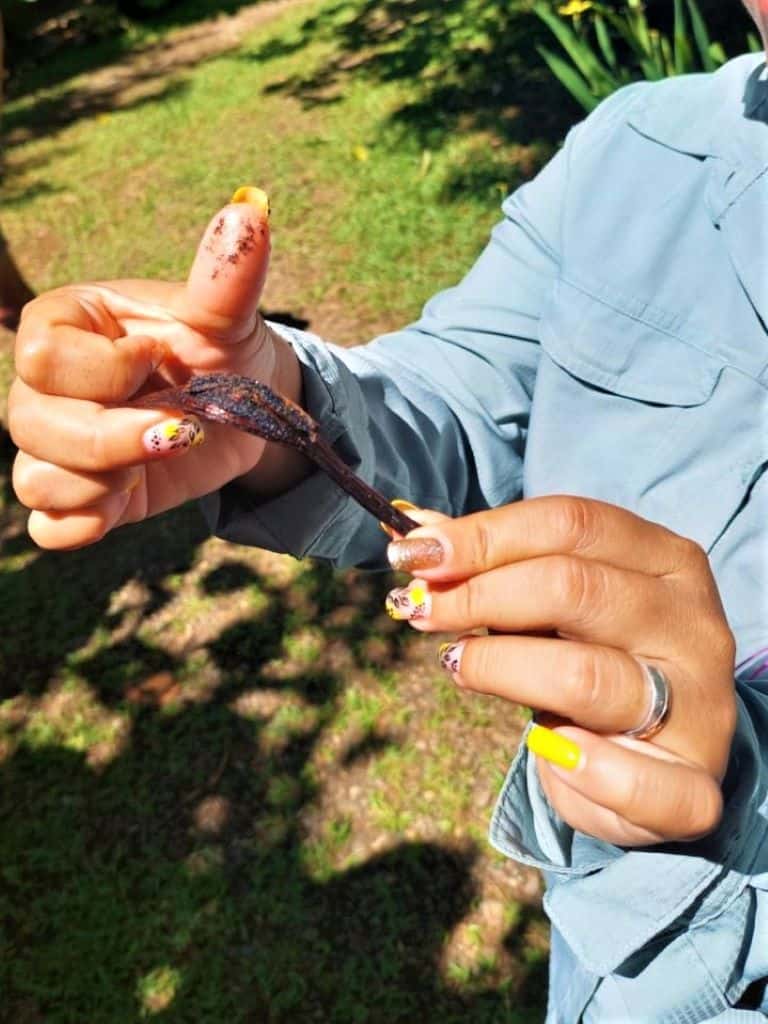
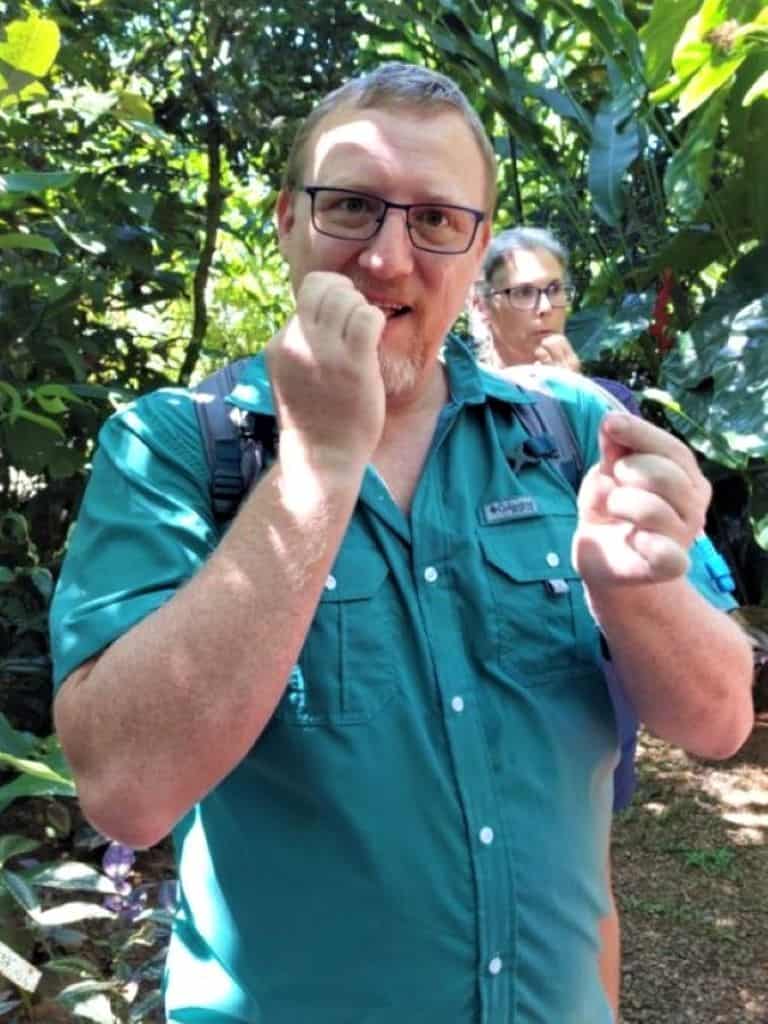
We also learned that clove trees take 10 years to mature before they can pollinate. Each time Joyce told us fun facts about a new plant or tree, she gave us samples to try as well as tree leaves to smell.
We even got a shaving of cinnamon bark fresh off the branch to sniff!
Tasting Time
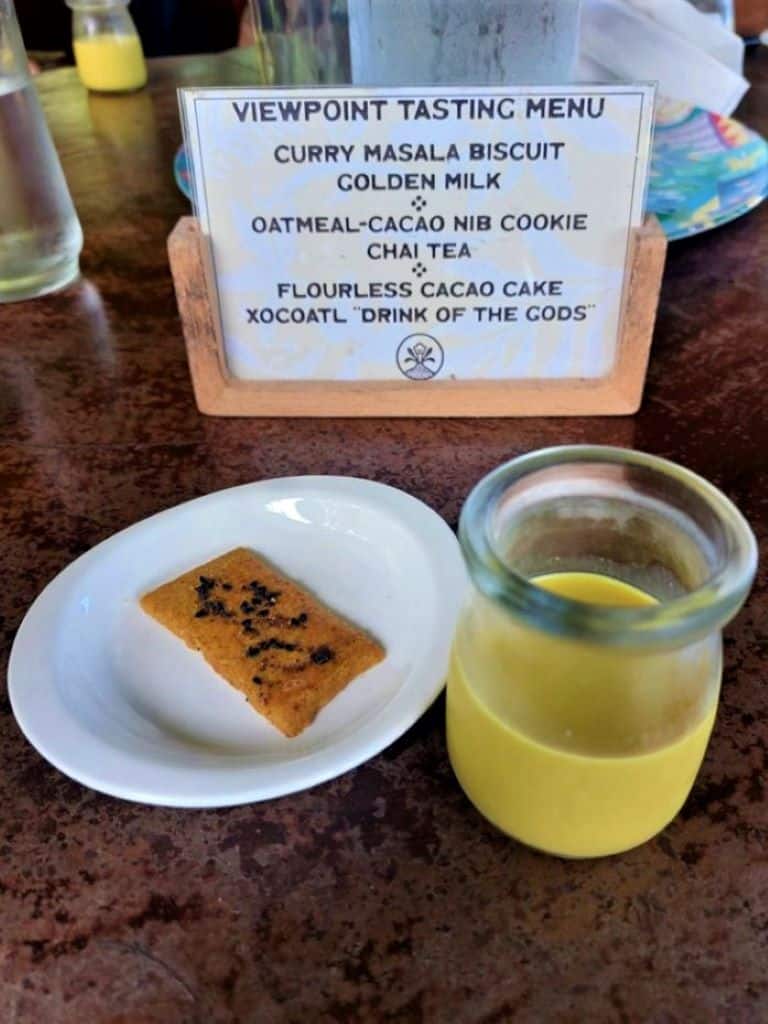
After passing the farm’s pond, you’ll head to the viewpoint where you will experience their “Flavors of the World” tasting.
The testing is three courses of bite-sized desserts paired with small drinks. Each homemade treat and beverage highlights different spices that grow on the farm.
Enjoy this all while looking out into the lush tropical rainforest.
It’s open-air but there are plenty of cooling ceiling fans. Little Man’s favorite was the chai drink and the chocolate cake, but I was partial to the golden milk drink. In all honestly, it was all pretty tasty!
Pro Tip: The tasting room is on the second floor and there are bathrooms on the ground level.
If you’re lucky, you may get a visit from the farm’s permanent residents while you’re there.
These include hummingbirds, scarlet macaws, toucans, and squirrel monkeys. We heard a toucan but didn’t see any, so they definitely are around!
Shopping
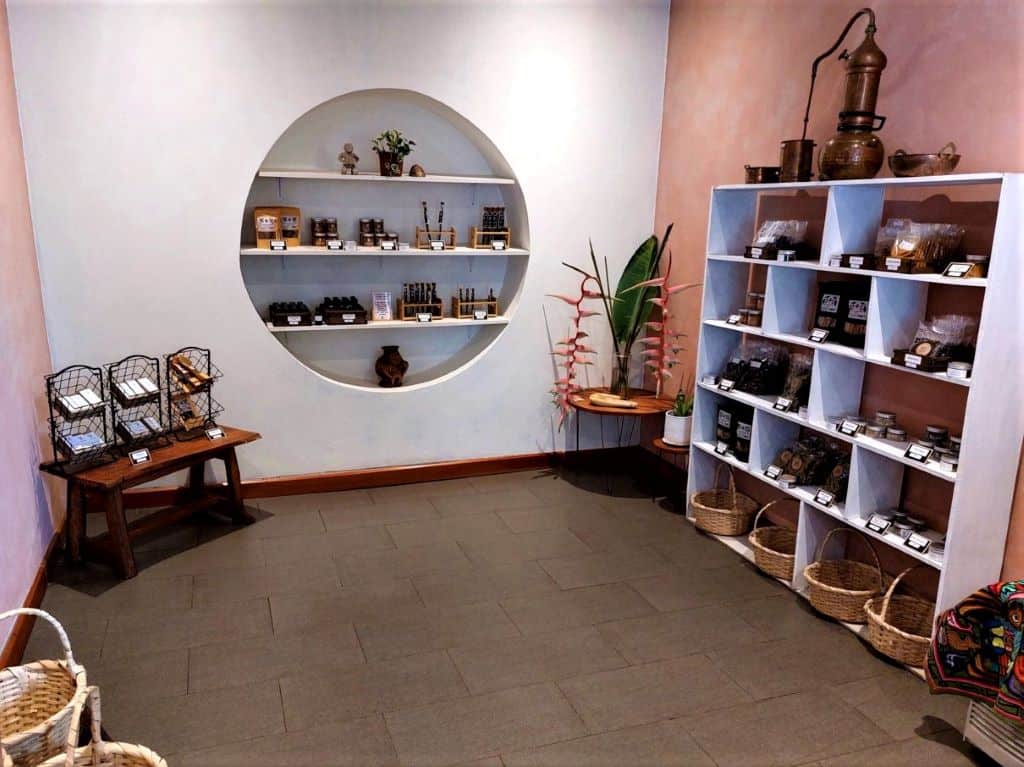
No trip to Villa Vanilla is complete without a visit to their spice shop.
Visitors and chefs alike can stock up on everything from vanilla beans and (real) extract and Ceylon cinnamon to their tree-to-bar chocolate bars and mixes that also you to replicate their tasting beverages again at home.
There are even other products grown on the farm that you can buy for yourself or even give as gifts when you get home.
We bought some vanilla and pepper to try in our own recipes, as well as some of the chai tea because Little Man claimed he wouldn’t leave the shop without it.
History of Villa Vanilla Costa Rica
Still not sure if you want to visit? The origins of Villa Vanilla Costa Rica are pretty interesting!
Henry Karczynski founded the family-run farm in 1987. He was born in Germany but raised in suburban Chicago (where we’re from!).
That’s where he studied business before finding his true passion working as a long-term project manager for several Non- Government Organizations (NGO).
He’s also been a short-term consultant in Central America and the Caribbean.
Henry’s arrival in Costa Rica was quite unexpected, and it is there that he founded Villa Vanilla Costa Rica.
Back then, the farm wasn’t much to look at as it was simply a cow pasture with a few trees scattered throughout.
Original Villa Vanilla Costa Rica Farm Techniques
The farm was originally managed using conventional agricultural techniques that focused on growing vanilla beans using one type of host tree (the coral tree).
Any plant that didn’t fit into the planting scheme simply got chopped down with a machete.
After several successful harvests with lady luck on his side, Costa Rica was hit by a succession of tropical storms that dumped eight meters (over 26 feet) of rain in just two years!
Vanilla production throughout Costa Rica came to a halt because of the use of excessive water stress and unsound agricultural techniques.
Henry decided to examine tropical agriculture in greater depth and develop more sustainable farming methods.
He read a book called Secrets of the Soil that prompted him to seek out more literature on non-conventional farming and attended conferences on biodynamic agriculture.


New Villa Vanilla Costa Rica Farming Techniques
Although it goes against what is typically done, Henry planted the same crop in a fungi-ridden soil.
He was able to use beneficial tools and information which taught him how to create an inviting environment for microorganisms which encouraged field repopulation.
The farm did a complete turnaround by using biodynamic principles to view and treat the farm as an organism, learning more about nature’s rhythms and cycles, and applying preparations of medicinal plants that encourage balance.
Villa Vanilla Costa Rica Spice Farm Today
Still today, the farm also practices other sustainable tropical practices that encourage bio-diversity.
Henry’s farm now includes a range of well-known herbs and spices, as well as modest plantings of everyday and exotic fruits, trees, flowering plants, and medicinal plants.
The flora has brought back the fauna that used to be present in tropical humid forests!
Birds, monkeys, and other animals are returning in droves. We saw monkeys on our farm tour and even heard toucans calling!

Final Thoughts: Villa Vanilla Costa Rica Spice Farm Tour
Touring the Villa Vanilla Costa Rica spice farm is more like exploring a spice forest. Most of the foods and spices grown there are trees rather than bushes or shrubs.
So the well-shaded experience surrounds you with spices and foods rather than feeling like you’re walking through rows of plants, like the El Salvador coffee farm we stayed on.
Because the experience is so interactive, it’s also a great experience with kids.
Although Little Man was the only kiddo touring on the day we visited, Joyce told us there was a group the prior week with 10 kiddos in it!
Overall, all three of us really enjoyed our time at Villa Vanilla Costa Rica and I do recommend it to others.


