
Our Offbeat Life contains affiliate links & participates in the Amazon Services LLC Associates Program & other affiliate programs. If you buy something using an Amazon or other link, we may receive a commission at no extra cost to you. See our Disclosure for more details.
How These Digital Nomad Parents Made Full-Time Travel Work With W2 Remote Jobs

Wondering what it’s like to be a full time traveling family with a W2 job? You’re in the right place!
In this article, we highlight the best features of our podcast on the very topic of making it work as digital nomad parents with full time jobs as well as offer the podcast links for your listening enjoyment. So let’s jump in!



Digital Nomad Parents Executive Summary
In this episode, we’re diving into the captivating story of a family who embarked on an epic 1.5-year journey through Mexico, Central, and South America, all while maintaining their US-based W2 remote jobs.
Balancing work, childcare, education, and adventure on the road, their journey is a testament to meticulous planning, adaptability, and the power of family bonds.
From using VPNs to manage time differences to taking advantage of local healthcare facilities, they navigated every challenge with resilience and grace.
This episode is packed with unforgettable experiences from the stunning landscapes of the Atacama Desert to the wildlife-rich Paracas National Reserve in Peru.
This family’s journey was enriched by connections formed with local families and fellow travelers along the way, giving their kids invaluable global perspectives.
For those considering similar paths, the Kellys offer practical advice: don’t overplan, trust in your children’s adaptability, maintain open communication, and ensure you have plenty of downtime for genuine experiences.
In conclusion, the Kelly family shows us that full-time travel and remote work can be a reality for families. Their journey has been filled with challenges, cherished memories, and deepened family bonds.
It serves as an inspiration for aspiring digital nomad parents. Their parting words: “Just do it!” Stay tuned for an inspiring and informative exploration of the Kelly family’s adventure!
Topics Covered
- Digital nomadism with a family.
- Preparations and challenges of long-term travel.
- Balancing remote work with travels.
- Educational arrangements for kids during travel.
- Planning finances for long-term travel.
- Health care and medical issues while traveling.
- Discovering new foods and cultures.
- Language learning and tackling language barriers.
- Housing arrangements during travel and keeping a home.
- The emotional and psychological impact of long-term travel.
- Plans for future travel and adventures.
Digital Nomad Parents Show Notes
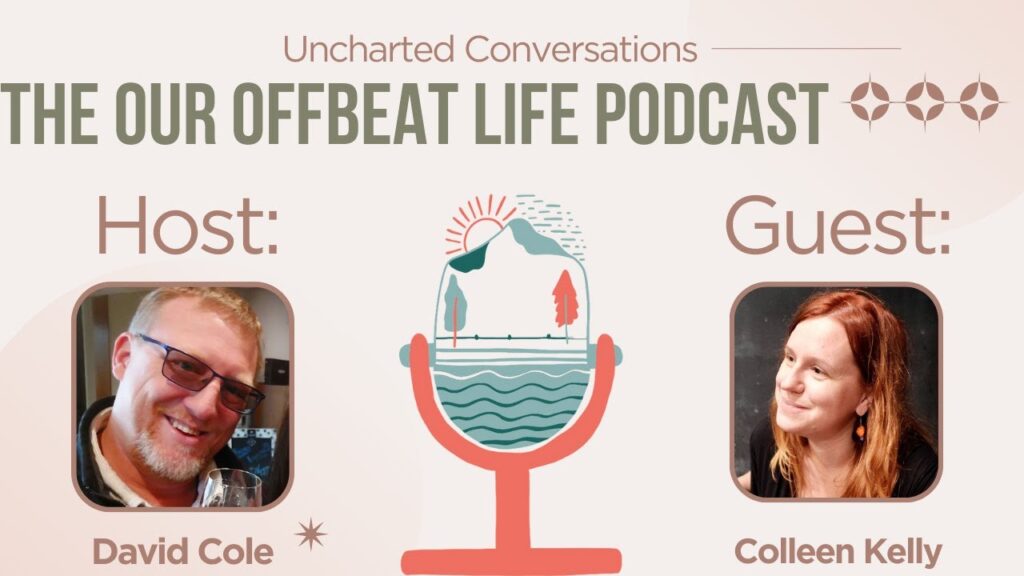
Podcast: Our Offbeat Life
Episode: “How To Be Digital Nomad Parents With A W2 Remote Job”
Guest: Colleen Kelly
Host: David Cole
Colleen Kelly is an experienced traveler, parent, and accomplished writer based in Pittsburgh.
With a deep passion for exploring the world, she has traveled extensively across the United States and beyond. Her adventures have not only enriched her personal life but have also shaped her professional path.
David is the owner of The Tutor Resource and host of the podcast Our Offbeat Life. His background is in education, specifically in tutoring, which led him to create The Tutor Resource, a platform designed to provide resources and support for tutors.
As the host of Our Offbeat Life podcast, he shares stories and insights from people who have created a life and career out of their passions and interests.
The goal of the podcast is to inspire and empower listeners to create their own offbeat life, breaking away from traditional norms and expectations.
For travel inspiration and guidance from families living this lifestyle, have a listen to Season 1, episode [#4 ] of Our Offbeat Life! Listen on iTunes and Spotify, or watch on YouTube.
Leave a Review!
Apple Podcast reviews are one of THE most important factors for podcasts. If you enjoy the show please take a second to leave the show a review on Apple Podcasts!
✔️ Click this link: Leave a review on Apple Podcasts
✔️ Hit “Listen On Apple Podcast” in the middle next to the picture.
✔️ In iTunes, Click “Ratings and Reviews” under the show name.
✔️ Leave an honest review.
✔️ You’re awesome!
Digital Nomad Parents Introduction
Welcome to another episode of Our Offbeat Life, where we celebrate the exciting and unique journeys of digital nomad parents! Today, we’re diving into the extraordinary story of the Kelly family.
They embraced the digital nomad lifestyle with open arms and hearts, embarking on an epic 1.5-year adventure across Mexico, Central, and South America – all while maintaining their US-based W2 remote jobs.
Though it seemed like a daunting task, the Kelly’s managed to strike a harmonious balance between juggling work commitments, childcare, education, and the thrill of exploration.
This wasn’t just a spontaneous decision. The Kelly family planned meticulously for their journey, but they also stayed flexible, ready to adapt and change course whenever necessary.
This combination of careful planning and openness to unexpected twists and turns was key to their successful nomadic lifestyle. Their journey is more than just an inspiring tale of adventure; it’s a roadmap for other families dreaming of following a similar path.
The Kellys’ experiences offer practical advice and insights, showing that being digital nomad parents isn’t just a pipe dream – it’s a viable, rewarding lifestyle choice.
So, whether you’re a seasoned traveler or just starting to entertain the idea of hitting the road with your family, this episode promises to be a treasure trove of inspiration and wisdom.
How They Made Both Full-Time Travel & Remote Work Possible
The journey began with both parents working remotely for a US company while they traversed through different countries and time zones.
Armed with reliable VPNs and a robust toolkit of digital resources, they effortlessly managed their professional commitments, no matter where their travels took them. Financial stability was a cornerstone of their adventure.
With a foundation of solid investments, a cushion of emergency savings, and the security of steady remote income, they funded their nomadic lifestyle without compromising their financial health.
We both started out working full-time remote for the same company. And I, about halfway in decided that we needed my time to, The focused more on planning the travel and focusing with the kids because planning the travel alone is a huge job.
Colleen Kelly
After a year, Colleen shifted her career to freelance writing, gaining flexibility and control over her time. This allowed her to focus on planning their travels and supporting their children in this unique lifestyle.
Education remained a priority throughout their travels. Their eldest daughter stayed enrolled in an online school curriculum, ensuring her education continued uninterrupted, despite the family’s constant movement.
In essence, this family has truly embraced the digital nomad parents’ lifestyle. They’ve successfully intertwined work, travel, and family life, creating a tapestry of unique experiences that continue to enrich their lives.
Biggest Travel Challenges & How They Adapted
Like any grand adventure, their journey was not without its fair share of obstacles and challenges. But the Kellys proved to be masters of adaptation.
When they decided to soak in more of South America’s beauty, they made a strategic shift from road to air travel. They stored their van in Costa Rica and took to the skies.
This was a move that allowed them to cover more ground despite the logistical complexities of crossing borders with three little adventurers in tow.
In true minimalist fashion, they whittled down their luggage from 27 bags to just five essentials, proving that less is indeed more when it comes to travel!
Healthcare, a concern for digital nomad parents, proved challenging. However, when their daughter needed medical attention for a minor injury, they discovered exceptional care at surprisingly affordable costs, unlike the steep prices back home in the US.
Bureaucratically, it was, a regular challenge, just like all things are when you’re crossing borders and storing cars with, you know, the government, but, but it worked out fine.
Colleen Kelly
Their journey was also shaped by the evolving landscape of remote work policies. Initially, they benefited from the vagueness of their company’s remote work rules.
However, as the company started enforcing stricter regulations, they took this as their cue to gradually transition back home.
In essence, the Kellys’ story is one of resilience, adaptability, and a keen sense of timing. Their experiences offer a wealth of insights for other digital nomad parents looking to embark on their own family adventures.
Unforgettable Experiences
- The Atacama Desert: This awe-inspiring landscape was a stark contrast to their verdant hometown of Pittsburgh. The vast expanse of the desert, with its unique terrain and dramatic beauty, left an indelible impression on the family.
- Paracas National Reserve: Nestled along the Peruvian coast, this stunning reserve was another highlight of their journey. They were captivated by the breathtaking scenery and the exotic wildlife that call this haven home.
The Atacama was the most Impressive thing to us. Jim and I and the kids, grew up in temperate forested places. You know, this was our norm and it had never been exposed to anything like that.
Colleen Kelly
But it wasn’t just about the places they visited. One of the most rewarding aspects of their journey as digital nomad parents was the connections they formed along the way.
They built meaningful relationships with local families and fellow traveling clans, creating a tapestry of shared experiences and memories.
Their children flourished in this unique environment, gaining independence, confidence, and a broader perspective on the world.
Immersing themselves in diverse cultures and forming international friendships enriched their lives in ways that go beyond the conventional classroom walls.
After spending 16 months abroad together, the bonds they forged were stronger than ever. Their shared adventure brought them closer, turning their journey into a treasure trove of unforgettable experiences.
So, if you’re considering taking the plunge into the world of family travel, let the Kellys’ story inspire you. Being digital nomad parents might be challenging, but the rewards are immeasurable.
Tips for Families Considering Similar Travel
Don’t overplan every detail – things tend to work themselves out as you go. Kids also adapt quickly to new environments and make friends easily across language and culture barriers.
- Embrace Flexibility: Don’t feel compelled to plan every minute of your journey. Often, the best experiences are those that are unplanned. Remember, things have a way of working themselves out as you go along.
- Trust Your Kids’ Adaptability: Kids are remarkably resilient and can adapt quickly to new environments. They have an incredible ability to make friends across language and cultural barriers, turning unfamiliar territories into exciting playgrounds.
- Open and Patient Communication: As a family, there will be inevitable challenges along the way. Maintaining open lines of communication and practicing patience can help navigate these bumps in the road.
- Slow Down and Enjoy: There’s no need to rush through your bucket list. Build in plenty of downtime to simply live and enjoy each destination at its own pace. Whether it’s hosting a movie night in Peru or taking extra days to stargaze in Chile, these quiet moments can often become the most memorable.
So, I mean, major differences are you’re doing what you do at home. So we’re going to the grocery store or markets. we’re talking to our neighbors, the best that we can, you know, like, we’re, we’re getting gas you know, it’s just, It’s living.
Colleen Kelly
Being digital nomad parents is less about ticking off tourist spots and more about immersing yourselves in the genuine rhythm of each place. It’s about experiencing the world together as a family, creating memories that will last a lifetime.
So if you’re considering this lifestyle, let the journey unfold naturally. After all, the adventure is in the journey, not the destination.
Conclusion
This wasn’t just a trip; it was a life-altering, horizon-expanding adventure that transformed the Kelly family in profound ways.
Yes, it required meticulous planning – from securing remote jobs and building up savings to considering educational arrangements for the kids.
But equally important was their readiness to adapt, to change plans when needed, and to face challenges head-on.
The obstacles they encountered didn’t deter them; instead, these hurdles strengthened their bonds and fortified their resilience. They discovered that navigating trials together as a family could be a powerful catalyst for growth and connection.
In the end, their advice to other aspiring digital nomad parents is simple yet powerful: “Just do it!” They firmly believe that the memories and experiences forged during such an adventure are priceless and everlasting.
I don’t think you have regrets when you take an adventure like this. It’s just, you know, amazing. And there’s challenges and. Can’t always be safe, then that’s never fun.
Colleen Kelly
The Kellys’ journey is a testament to the possibility of combining full-time travel with remote work, even with kids along for the ride.
It’s about intentional planning, mutual support, flexibility in the face of unexpected challenges, and immersing oneself fully in the everyday life of each new destination.
This adventurous family didn’t just travel; they lived, loved, and learned, creating stories that will echo through their lives.
Their experience serves as an inspiration for all digital nomad parents out there, showing us that with the right mindset, the world can indeed become our playground.
Stay tuned for more inspiring stories and practical tips from Our Offbeat Life!
Key Takeaways and Timestamps
[00:00:00] Introducing Colleen Kelly and her family’s extended travel journey through the Americas
[00:01:05] Background on Colleen, her husband and their three young kids
[00:02:20] Decision to take the kids abroad stemmed from their own meaningful prior travel experiences
[00:03:55] How some favorite destinations were entirely new for the kids to explore
[00:04:35] Managing education – enrolled oldest in online school, but now homeschool
[00:05:55] COVID accelerated their transition into full homeschooling
[00:07:03] Decision to store their van in Costa Rica and fly to see more of South America
[00:08:38] Logistical challenges crossing borders and flying with three young kids
[00:10:42] Preferences between driving vs. flying for family travel
[00:14:22] Key differences between vacation travel and long-term family living abroad
[00:15:29] Relied more on personal planning than outside resources
[00:17:02] Navigating remote work policies and restrictions
[00:18:52] Managing time differences didn’t ultimately cause issues
[00:19:48] Careful financial planning to fund extended travels
[00:22:58] Kids transitioned well at home and abroad; parents had bigger re-entry challenges
[00:24:31] Tips for other traveling families – go with the flow, kids adapt quickly
[00:25:17] Didn’t overplan every healthcare/logistics detail which worked out
[00:26:25] Intentionally sought out travel community connections
[00:27:54] Life balance and schedule coordination resolved itself long-term
[00:29:13] Gave kids deciding vote on travel bucket list priorities
[00:30:36] Kids still reminisce fondly about people, animals and food experiences
[00:31:34] Favorite destination for food was Mexico; least favorite was Nicaragua
[00:33:18] Luckily had minimal health issues; affordable care gave peace of mind
[00:35:05] Only regret was not traveling even longer if possible
[00:39:46] Best coffee was Guatemala; worst was instant Nescafe
[00:42:29] In a zombie apocalypse, would grab her meticulously prepared emergency bag
[00:45:11] Parting advice: “Just do it!” – amazing experience that’s worth it
Transcript
[00:00:00] David: Hello, adventurers. Welcome to another episode of the Our Offbeat Life podcast. Today, we are thrilled to be chatting with the amazing Colleen Kelly, a traveler.
[00:00:13] David: She’s a writer who, along with her husband, Jim, and their three young adventurers, traded their day to day life for a year long, I think over a year long of exploring Mexico, Central and South America, all while working full time. So, hello Colleen. Hello. Welcome to the podcast. How are you
[00:00:38] Colleen: today? Thank you so much for having me.
[00:00:41] Colleen: yeah, great. yeah, it was about a year and a half. and we are back at home in Pittsburgh and it’s beautiful summer day.
[00:00:51] David: Very cool. Very cool. Yes, I love being able to talk over these distances. we’re currently in Argentina. You’re all in Pittsburgh. so it’s pretty cool. for those who aren’t familiar.
[00:01:05] David: with you at all. Can you give people a little background about who you are?
[00:01:10] Colleen: Yeah, sure. so I’m Colleen. My husband is Jim. We have three kids. They are now, nine, five and four. but when we left on the trip, this will take some math. They were six. Three and had just turned to, and we left our home in Pittsburgh, with the intent to drive to and from Costa Rica on the Pan Am, and plans changed along the way, which was great.
[00:01:38] Colleen: but we did journey for about a year and a half, few different methods, changing timeframes and just kind of kept things in flux, but it was an awesome adventure.
[00:01:48] David: Awesome. Awesome. Was it always supposed to be a, um, a year and a half or a short term one or is it going to be longer?
[00:01:58] Colleen: Yeah, the, our initial timeline Was about a year and a half.
[00:02:03] Colleen: however, during that time, we did both extend it and shorten it at different times, depending on how our needs or desires were changing. and then in the end, we did, we did kind of hit our target. But yeah, so we just kind of kept adapting.
[00:02:20] David: Yes, that’s the name of the game with family travel is adapting, yes.
[00:02:24] David: Yeah. What led you up to taking your family on such an epic adventure? You know, thriving, North and Central America, it sounds daunting to people.
[00:02:36] Colleen: Yeah, it, it does sound daunting, and it was to us, I, maybe like, We cheated a little. We, I had some experience in the area, as did my husband. separately and together.
[00:02:49] Colleen: So we, always knew we wanted to travel, but we did kind of pick lands that we were familiar with to kind of, ease into it a bit. so, I started traveling on my own about 15 years ago, Costa Rica, Mexico, Guatemala. when Jim and I met, we did Ecuador, Colombia, Peru. and so when we started our family, we kind of just knew that we had to give our, like, we were so wowed by our own experiences and impressions that we knew we had to share that, with our kids because it was so incredible.
[00:03:22] Colleen: So, and we really wanted to expose them to ideas that like, you know, there are many places, many people, the U. S. is not the only version of truth, and things like that. So, we wanted to prepare new foods, learn new languages, and so, we just, we knew we had to get them out there to see it, to experience it, yeah, and it was
[00:03:40] Colleen – Offbeat Life Interview – Made with Clipchamp: awesome.
[00:03:41] David: That is awesome, yeah. So your kind of your past travel, dictated to you your future travel. I mean, you knew what you liked, you knew what you wanted. Yeah. that’s awesome. But then it was obviously different with kids.
[00:03:55] Colleen: Yeah. Yeah, so it was interesting because some of the things when I was solo backpacking as a late 20 something that were not my favorite things at the time turned out to be some of my favorite things that we were doing as a family.
[00:04:13] Colleen: So that revisiting. Kind of even tied myself together full circle as a traveler, because it was a whole new experience, even though I’d been there before.
[00:04:24] David: Yes, I would imagine that would change it quite a bit. Yeah. What did you end up doing for education for each of your kids throughout this time frame?
[00:04:35] Colleen: Yeah, so. one thing I was grateful for was that two of our kids were pretty young, and so they were not officially school age, and that kind of Going into this, it’s like, that’s the big question, right? What about school? And so, having only one of them school age kind of released the burden of that a little bit, because the other two, we were fine.
[00:04:57] Colleen: Like traveling was the only school. And, that was fantastic. but with our oldest, we did have her enrolled in like a virtual private school. she had an assigned curriculum, but it was still very parent coached. and we, and we did do that for the nearly two years that we were out traveling.
[00:05:15] Colleen: turns out we’re like really just. Kind of dedicated homeschoolers. And now this year we are just homeschooling. so we’ve let go of the, we’ve let go of the virtual school entirely, to really focus more on kind of self led education. So the whole child education thing, and now my second is also school age as well.
[00:05:34] Colleen: And we’re also homeschooling her. So, it was kind of a transition that, you know, we were like COVID kind of pushed us into resisting the traditional school method we did virtual now we’re doing homeschool and throughout that. Feel like we found our place.
[00:05:49] David: Very interesting. Yeah. and a lot of people in the US are familiar with homeschooling.
[00:05:55] David: little less so with, child-led learning. yeah. And people which we meet all around the world. It’s very foreign concept. Taking your kid out of school. so like was it’s just the covid, that led you into this lifestyle or before you had kids, were you thinking of this lifestyle, of homeschooling and child-led learning?
[00:06:15] Colleen: Yes, so, we had begun planning our trip in 2019. and when I say began planning, I mean, kind of making sure our finances were in order looking for that remote work that we felt was key to really being successful. but the education piece we had not figured out yet. That COVID was kind of the protagonist for that piece, and it just turned out to work perfectly for us.
[00:06:38] David: So that’s good. That’s good. When the pieces kind of fall together, your lifestyle to the way your kids learn. Yeah, that was awesome. Now, when we last chatted IRL, we were in Costa Rica together. What was that about a year ago? I think you were planning on putting your van in storage to take to the skies and explore South America.
[00:07:03] David: Yep. How did that adventure unfold?
[00:07:08] Colleen: Yeah. so that was kind of the first piece where we felt like we had to kind of majorly adapt to something. when we got to Costa Rica, we, the initial plan was to turn around, but we did not feel done in a lot of ways. We wanted to keep going. We wanted to keep seeing more.
[00:07:27] Colleen: We wanted to see things that were new to everybody. We kind of slowly introduced ourselves to full time travel. By going to places we’d had already been, but we were ready for more. So, we decided to store the van and fly to South America. also, we were running up against our deadline, for time, and also our, our budget.
[00:07:49] Colleen: So, we, thought that this would be an economical way to see more, while. Also kind of saving some money now that turned out to not be true. we did. It was not less expensive. but it did save time. and You know, it’s just amazing, probably one of the things that stick most in our mind as we kind of reflect on our travels now is, that stark difference from Costa Rica to Peru, in landscape because tropical to desert, is just, like such an awesome reminder of how big the world is, how vast and varied it is, and how the landscape affects the culture is, and so, like, this is probably one of the things that remains in The most, that was a result of this decision to store the van and start taking flights.
[00:08:38] Colleen: Bureaucratically, it was, a regular challenge, just like all things are when you’re crossing borders and storing cars with, you know, the government, but, but it worked out fine.
[00:08:49] David: That’s cool. So you ended up going through which countries by air, by air?
[00:08:55] Colleen: Yeah, so, we did, southern Lima and south southern Peru and Chile by air, One international flight between Peru and Chile, and then a lot of commuter flights within those countries.
[00:09:06] Colleen: I think our flight total was about 13 flights, and that was over just three or three to four months, like, I don’t know, 13 weeks or something. So, it was. Pretty. It was pretty intense. It was a lot of flights with a lot of kids.
[00:09:22] David: Yes, I could imagine 13 flights, like three months or so. Wow. Yeah.
[00:09:28] David: Yeah. That seems driven. And flown through the America journey, which, which one do you prefer and why?
[00:09:39] Colleen: Yeah, so I think we’ve talked, you know, we talk about this among ourselves because they, it was both were really cool in their own ways. I think the. The restriction of driving was that you kind of had to pick a route.
[00:09:53] Colleen: And if you were going to deviate from that, it was a huge change in the amount of time you were going to spend, flying. We got to go to places. Maybe we wouldn’t have been able to because it was, you know. An hour flight, but it could have been a 20 hour drive on mountain roads. So we got to kind of get out there and see more than I think we would have not being forced to like pick a certain route.
[00:10:15] Colleen: But at the same time, we lost a lot of flexibility, with three kids having to get them. To airports on time with the amount of luggage not forgetting things that your Airbnb constantly. that was a bit of a logistical challenge. and driving, allowed us to really see things the way that they are when you’re driving through villages and on the roads and, you know, seeing the sunset and sunrise as you’re driving.
[00:10:42] Colleen: It’s just, it’s just incredible. So, Our preference again, should we do it again would probably be to drive. but I think if your kids are older and you want to fly, that’s totally okay. Our, our hesitancy there would just be the amount of luggage that young kids require.
[00:10:59] David: Yes, they do require some unique things like.
[00:11:03] David: What did you end up taking with you, when you left, like, the van behind to fly? Like, what made the roster?
[00:11:11] Colleen: Yeah, that was, packing was probably the most difficult, consistently most difficult thing because, you’re going through different seasons, different terrains, different altitude, you know, and that’s constantly changing.
[00:11:25] Colleen: so I think we, I think when we left, we started with in our, 2007 Honda odyssey, 27 pieces of luggage of various sizes day back, you know, some small day bags, whatever, but coolers, all kinds of things. by the time we came home, that was reduced by half because as we go, we shedded some things that were unnecessary.
[00:11:47] Colleen: when we stored the van. Things that, we kind of considered too precious to leave. But too valuable to travel with on airplanes, like our guitars and our extra computer monitors for work, things like that, we wound up shipping back to the US, before we stored the van, things that made the cut were like, absolute necessities.
[00:12:10] Colleen: We had it pared down to five bags, for Thanks for joining us. Our South America leg. we needed the kids to be able to help carry stuff. So that was what can they fit in their backpack? That’s a tablet and a coloring book. And like, that’s all that made it clothes. things that we We were a lot more willing during that part because we were limited in space to kind of be flexible and maybe buy or pick up things that we needed along the way, whereas for, we tried a bit more to work with what we had.
[00:12:42] Colleen: I think that changed a little bit.
[00:12:45] David: Well, okay. Yeah. Kids change the mix of what you end up taking and what they can carry themselves because especially young kids, you know, you don’t want to be too heavy of a bag and then they complain and or can’t. Yeah. Yeah. Yeah. So yeah, I totally understand that. So that’s one of the logistics, but I’d love to hear some of your most unforgettable experiences.
[00:13:10] David: These moments from the journey. Do you have any hidden gems or any challenges?
[00:13:16] Colleen: so probably, I think kind of like I said, the Atacama was the most Impressive thing to us. Jim and I and the kids, grew up in temperate forested places. You know, this was our norm and it had never been exposed to anything like that.
[00:13:34] Colleen: our kind of gem was Paracas, Peru. and just got to experience landscape and climate that we’d never seen before. You can’t understand its existence until you’re in it, and, and it was just fascinating how we were there during sandstorm season. That was just incredible when, you know, it’s just raining sand,and then just, the adventure, the dune buggy rides, the wildlife that was so different than the tropical places we’d come from.
[00:14:02] Colleen: so I think for us that, that was, yeah, That was our, that was our gem. That was the one that we found that was like, yeah, we’re so glad we did this.
[00:14:11] David: That’s amazing. And, and it sounds like it’s more than just like a family vacation. It sounds like it’s a lifestyle, being a digital nomad for a year and a half or more.
[00:14:22] David: so how would you describe it, or describe the differences between taking a family trip and doing this lifestyle of immersing yourself like this?
[00:14:33] Colleen: Yeah. So, I mean, major differences are you’re doing what you do at home. So we’re going to the grocery store or markets. we’re talking to our neighbors, the best that we can, you know, like, we’re, we’re getting gas you know, it’s just, it’s, It’s living.
[00:14:52] Colleen: So everything that you do at home, you just do somewhere else. And all of those tiny things just add up to. An experience, that you learn from, some things are challenging, that you don’t expect, like access to clean water. That is something that we take for granted, that you can’t take for granted.
[00:15:10] Colleen: and, similarly reverse, you know, I love the safety measures in the US that don’t exist elsewhere. So, you know, so it just, it just depends, but you, you live your life, and you live it. among people who are living their lives, and it’s, you know, it’s not a vacation.
[00:15:28] David: yeah, that’s putting it succinctly.
[00:15:29] David: It’s definitely not a vacation. Yeah. What are some resources that were really helpful during the planning process for full time travel?
[00:15:40] Colleen: Yeah, so, I didn’t, I didn’t, Use a ton of resources. you know, there are some Facebook groups, websites and things like that, that are out there, for people to rely on.
[00:15:50] Colleen: but for us, it was such a, I felt like such a personal thing. we didn’t. Really want to like do it anyone else’s way. So when I think of the planning for us, it was more, kind of about coming up with our budget. But again, that was so personal because that is going to look different depending on your family.
[00:16:11] Colleen: and how you travel, how much you want to go out and do. and, yeah, so, and it was a very democratic process. So when we were deciding Yeah. Where to go and what things we wanted to prioritize doing. you know, we asked the kids and we took their opinions into account. and so they were a very active part of all the activities that we chose.
[00:16:30] Colleen: so yeah, I don’t know that we depended a lot on outside resources. I felt like all of our resources just kind of came from within our family and we grouped them together, so that we could make it our best journey.
[00:16:41] David: yeah. Okay. Well then, I know that Jim worked as a time remote employee for a company in the US, throughout this, throughout this time, were there any restrictions to or challenges in your travels because of his W2 employment status.
[00:17:02] Colleen: So that was kind of a tricky thing. and actually we, we both did, we both started out working full-time remote for the same company. and I, about halfway in decided that we needed my time to, The focused more on planning the travel and focusing with the kids because planning the travel alone is a huge job.
[00:17:24] Colleen: So we, you know, decided to kind of divert some of that energy. and, I know that there are like tons of secret nomads out there and I’m not going to say too much because my husband still works for this company, but, there were no problems, so there were some very vague restrictions in place.
[00:17:39] Colleen: but we did not come up against anything that was truly restrictive. So there were tools are out there that we used to make sure that, he could work where he needed to work and when he needed to work. and that meant. You know, time changes, VPNs, things like that. but it wasn’t a problem, when they finally did, 12, 15 months into our journey, kind of start to restrict that more, that’s when we really, at the same time, start to respond by trying to get home more quickly.
[00:18:14] Colleen: So, the last few months, the last three months of our trip were very quick. Whereas we spent nearly a year getting to Costa Rica. We spent about six weeks getting home from Costa Rica. So it was a pretty quick turnaround. but so yeah, we just kind of rolled with it. wasn’t off the table and wasn’t sanctioned, but we just, we just rolled with it.
[00:18:37] David: Okay. Okay. how was the time difference for him? Working. Was that difficult to balance for meeting schedules or deadlines or anything like that while traveling?
[00:18:52] Colleen: It was a little tricky. thankfully it wasn’t huge. I think that at one point, I think the most we had was just a two hour difference. so it, it was. and also kind of helpful, actually, in some ways, because it actually freed up some more time for us, either in the morning or in the afternoon to actually go out and do activities.
[00:19:15] Colleen: I think it’s, a family before or after the work day began. So we kind of just seize that opportunity to just make it a good thing.
[00:19:23] David: Okay. And one of the things I always hear from people that are thinking about doing this type of lifestyle, maybe it’s a gap year. kept two years, something like that. How do they, how do people finance this?
[00:19:37] David: Like, what did you guys do to, go on this? Were you just living on your normal money? Were you, did you have a nest egg? Did you budget properly? What did you do?
[00:19:48] Colleen: Yeah. So, we took, this was probably something that we were the most careful about, as far as planning. And so we kind of had a varied approach.
[00:19:56] Colleen: We own our home in Pittsburgh. For us, it was important for us to keep that. We wanted the security of if should we need to come home that that was there for us. So we did keep our home, although tons of people don’t. And I think we should have not in the end, but,so we did keep our home. We had some investments spread out.
[00:20:15] Colleen: We had a nest egg and, you know, reasonable. and then we had, we both had regular income, for the first three quarters of the trip. when I started freelancing, it was regular coupled with freelancing income variable. but, We felt more secure just by having, a fair amount of money in different places.
[00:20:36] Colleen: And we spent a couple years making sure that we had that because that was our security. it’s not that for everybody, but that was ours.
[00:20:45] David: Okay. Okay. And tell us about like the freelancing. How did you get into that? Is it something that is for everybody? Or like some people are like, Ooh, look, I could work on the road writing.
[00:20:58] Colleen: Yeah, yeah. I don’t know. So thankfully, we were financially secure enough that it was a good time for me to say I’ll try this. and traveling, has always been my lifeblood. I was so inspired on the road that I was like, well, now is my time to write that been the dream. So, you know, for me, it just, started out by I just you.
[00:21:21] Colleen: Was reaching out to my network’s places that I knew kind of what they call cold pitching and saying, Hey, do you need some help? and it kind of grew from there. I. I think if you have the full time to dedicate yourself to being a freelancer, then it is successful as a mother of three as, you know, a family manager.
[00:21:44] Colleen: I don’t have full time resources to dedicate to freelancing. So, in my position, I wouldn’t say that I could rely on it solely. should we do it again? We would still very much rely on the W two income. but I think for a lot of people, it’s totally possible if you can really dedicate yourself to it.
[00:22:01] Colleen: it’s just a lot of background work.
[00:22:03] David: Very cool. Okay. And now kind of settling back in, after such an extraordinary journey. how was the transition back to life in the U. S. for everybody, kids, both of y’all?
[00:22:22] Colleen: Yeah, so I think one of the coolest things to see was the kids transition throughout the trip and then transition back to home and to see them thriving regardless in any scenario they were thriving and so You know it for us in the end.
[00:22:42] Colleen: It’s just a win win. We were worried that they would struggle to adjust along the way we were worried they would struggle to adjust when we got home. they haven’t struggled more than kids struggle with day to day things already so it’s been very normal, and I think we’ve intentionally normalized it.
[00:22:58] Colleen: but it’s it’s Yeah, it’s been great for them. They, they haven’t really had any trouble adjusting. We’re back in the full swing of jam packed American lifestyle. and it’s, it is what it is. It’s fine. for, Jim, he’s so go with the flow. He kind of really misses the freedom of just being out there.
[00:23:17] Colleen: Things are really structured and that, that was hard to adjust to, the really rigid structure here. and then for me, I’m just not good at being stagnant at all. So I just feel like I have to be out there, and see and experience it. So I think, it’s been the hardest for me. I also was the one to kind of spearhead this.
[00:23:36] Colleen: So that makes sense. so, you know, I’m always planning the next trip. I’m always ready to get out there.
[00:23:42] David: What’s going to be the next one that you’re working on?
[00:23:45] Colleen: Yeah, I think, I think probably a similar length road trip. but through Europe, that’s what we’re leaning towards.
[00:23:53] David: Yeah. You’re gonna do car, plane, train.
[00:23:57] David: Yeah. A little bit of both.
[00:23:58] Colleen: Car, I think. Car. Probably, probably car and train a little bit. We’re, we can’t jump back into planes quite yet, but. No.
[00:24:06] David: Yeah. Okay. Okay. and let’s see, talking about other families. There’s a lot of families that I’ve talked to that are listening that are Looking at getting into this lifestyle, and they’re considering that similar path, maybe going through Central and South America.
[00:24:27] David: Can you share some helpful tips?
[00:24:31] Colleen: Yeah. so I, I think it depends. I’m like a sort of super planner type person. So my struggle at first was Kind of worrying about all of the details. So, the medical care and mechanics friends for the kids, language immersion. and before we left, it was so easy for me to focus on those things.
[00:24:51] Colleen: once you’re there and out there and doing it, day to day life is so. Interesting and beautiful that all of those things that you thought were going to be so important really turned out not to matter that much. so for anyone who’s kind of a planner like me and worried about details, I would, my advice would be to not dwell on that as much as you think you need to, because they work themselves out.
[00:25:17] Colleen: the one time we needed medical care. X rays cost 22 like it was, we didn’t use the insurance that we spent time looking for, you know, so just things like that, to not really worry about what it’s going to turn out to be like, and then the kids, they’re so resilient. they’ll find friends.
[00:25:35] Colleen: They’ll pick up the language quicker than you expect. you know, before you know it, they’ll be out playing with residents, of the neighborhoods and you’ll meet friends along the way, that you’ll feel so aligned with and connected to that you’ll kind of know through the rest of your life and that’s an awesome thing, for the kids to always know that those people are always out there too.
[00:25:56] Colleen: Yeah, there’s this forgiveness when you’re on the road because everyone’s out there doing the same thing. and so, it’s so nice to have that, to feel that grace towards yourself and towards others. knowing that you’re all sharing it and you’re all in it. yeah, so my advice is just kind of to put your faith in the process.
[00:26:12] David: That’s awesome. I mean, it sounds like you found a new community while you were traveling. was that intentional? Did you seek out community or were you finding people along the way as you went?
[00:26:25] Colleen: so, you know, I would kind of just reach out to, Facebook. But groups, both, those that were global or, for expats in the communities, and found people to hang out with that way.
[00:26:36] Colleen: And sometimes those relationships were for an afternoon and it was awesome. And sometimes they lasted longer and, and will last. and so it’s, yeah, the community is out there and it feels great when you, When your kids, especially meet people that are out there doing a similar thing, because it really helps them understand that their experience is.
[00:26:59] Colleen: It’s totally validated and normal and there are other people out there having an adventurous life.
[00:27:06] David: I remember when our kids met and it was then they were together for a couple of hours and it was hard to even separate them at the end of that first, that first time. Yeah.
[00:27:16] Colleen: Yeah. So great. Yeah.
[00:27:18] David: So, I mean, kids latch on together.
[00:27:20] David: They, they have, they, they build relationships so easily. so that kind of makes me think about advice for. balancing the work, the travel, the family time, that type of thing while on the road. Do you have any thoughts on that?
[00:27:39] Colleen: Yeah. So, that was, you know, another one of the things that was just kind of like, you know, started out as a bit of a worry and just kind of melted away, because especially long term, it works itself out.
[00:27:54] Colleen: So we just, Made sure that we were constantly communicating and constantly being flexible with one another. so if there were meetings, if there were live classes, You know, most of the time we worked our schedules around them, but if we couldn’t, then that was okay too. and thankfully people. Were supportive if we had to miss something, because it was a travel day.
[00:28:17] Colleen: so. We just really, just kind of went with the flow and we also tried to make sure that we were balancing, our activities with our downtime. That was difficult at first because, when you start, you kind of have a bucket list of things. and it feels a bit more like vacation, but as it rolls out a bit more, you learn.
[00:28:39] Colleen: Remind yourself that you’re living and the downtime is just as important as getting out and it’s okay. If you don’t see that fifth ruin, it’s okay. If you know, the kids just want to watch a movie, even though they’re in Peru, like, this is fine. so, it did take a few months, but finding that balance, the life balance, among all these things, the same kind of life balance you would have at home, just apply that to the, to your time on the road.
[00:29:05] Colleen: yeah. And it’ll be fine. Nice.
[00:29:07] David: Very, very nice. What, what was on that bucket list when you left originally?
[00:29:13] Colleen: Oh, so, you know, we kind of left that up to the kids, cause we had done a lot of it. So, personally, so it was, so it was really cool to let them kind of lead that way. They all had different interests.
[00:29:25] Colleen: so for our oldest, she’s very much into wildlife. So we had to, anything that came up with. Animals was a must see for her. so we did turtles and whales and dolphins and flamingos. And so it was, everything. And then, our middle daughter, she’s super into space and astronomy. So we had to do Chile and we spent, I think it was, gosh, two or three weeks just in, the Valley of the stars in Chile, just kind of exploring that area because she was.
[00:29:54] Colleen: So happy to be there. We didn’t need to move on. and then our youngest, he, he was a bit on the young side, but he loved anything with boats and beaches. So anytime we came upon something and there’s the flexibility, it’s like, all right, well, we’re just going to do this boat right now because. He’s gonna love it.
[00:30:09] Colleen: So, yeah, so it was great. Probably our top activities was, dune buggy rides. We swam in bioluminescent waters, tons of ruins. Machu Picchu was fantastic. and then, yeah, exploring the Tama and Qatar is a beautiful, canyon, in the Atacama. just tons of amazing things.
[00:30:29] David: Yeah, that’s cool.
[00:30:31] David: What do the kids still talk about now that you’ve been back for a little bit?
[00:30:36] Colleen: Yeah, so kind of, kind of the similar stuff. And then, we’re so fond of everything. We have pictures all over. So our photos, our digital photo frames prompt a lot of discussion. Oh, do you remember that? You remember that? You remember that?
[00:30:50] Colleen: they really remember, Things that would stand out to them at home, holidays, birthdays, things like that, that had different blends of traditions, were really interesting to them and those are things that we still talk about. also the foods, different foods that we came across. Do you remember when mom accidentally ate ants?
[00:31:09] Colleen: That kind of stuff, like just the funny moments, you know, all the stuff kids love.
[00:31:14] David: Yes, yes. Oh, you gotta love the food. There’s so many different things. Sometimes you’re, uh, uh, regret it. Sometimes you love it. Yeah. Which, which country had the best food?
[00:31:29] Colleen: Ooh, yeah, that, just Mexico, hands down. Mexico?
[00:31:34] David: How about the worst?
[00:31:34] Colleen: Yeah. ooh, I, I’m hesitant to say, but, I’m not, I was not a fan, I’m vegetarian, so, foods that were very, countries that were very meat centric were difficult, but overall, probably central, I was not a fan of Nicaragua food, I’m not a big fan of Costa Rican food, and also, Chile would be at the bottom.
[00:31:56] David: Okay. Okay. But Mexico is at your top. What was it about Mexican food?
[00:32:02] Colleen: I fell in love with one particular thing, that changed my world. And that is salsa matcha, which is just this incredible blend of chili oil and sesame seeds and chopped peanuts and garlic. And, it is a condiment in the Chiapas state, that you, I put on everything now.
[00:32:21] Colleen: it’s hard to find at home, but I found it. All
[00:32:24] David: right. There you go. Yeah. That’s the thing. Travelers always remember the food. Yeah. We might sometimes get ruined out, so to speak. Yeah. But we don’t get fooded out.
[00:32:42] Colleen: We don’t. We don’t get fooded out. I will always go to that restaurant. Anyone.
[00:32:49] David: All right. All right.
[00:32:51] David: I know earlier you mentioned that you had a health care. scare, you had to get x rays. how did you handle health care? when you were traveling, like what was the big issues that came up?
[00:33:07] Colleen: Yeah, so I, I think we were very lucky. we did, there are so, many agencies that offer, but we did get international health insurance.
[00:33:18] Colleen: that would cover us. And for us, it was like, just, kind of in case of emergency situation, you need to get helicoptered out of there or something like that. super unlikely. but we had it, Full disclosure, we did not renew it our second year. it was. So healthcare was so inexpensive and we felt quality enough that we weren’t concerned.
[00:33:38] Colleen: Should we need should we need care again? we had 1 situation. Our daughter was running fell bumped her head. Pretty standard. She was four. so we took her in just to make sure, and she was fine. But yeah, it was like 22. We have the x rays to keep. It’s one of our souvenirs. it was just, You know, and it was so easy.
[00:34:02] Colleen: It took, I think it was about an hour and a half to get in and get out, get home. She’s fine. So things like that just kind of unheard of, in the US, regarding both cost and time of care. So we experienced that early on enough, unfortunately, but fortunately, that we were not worried about it going forward.
[00:34:24] David: Okay, that’s cool. I sure have to worry about it going forward with three kids accidents happen.
[00:34:32] Colleen: Yeah, accidents happen. Yeah. And they happened about the same rate and severity as they would have in our own home. We felt like so we were a little bit more vigilant. there are some things that don’t exist.
[00:34:47] Colleen: With the same frequency like railings on stairs, for example, takes an extra extra eye, but you get used to looking for that kind of stuff.
[00:34:57] David: Okay. And finally, I mean, looking back, would you change anything about your journey?
[00:35:05] Colleen: I, I would not have ended our journey. I would, I wish, you know, I wish we would have, yeah, I wish we would have sold the house.
[00:35:17] Colleen: but I think, Yeah, I think we also have pets at home. So we’re very attached and we had wonderful house sitters that cared for our home and our pets and plants. so, I think that’s a big thing for families who have pets that they don’t want to leave behind. So that that is really hard. and so we chose to have the house sitters.
[00:35:35] Colleen: I, you know, feel like we had a lot more endurance and us. I feel like the benefits that we were Receiving both learning experiential, like getting closer as a family. I don’t think that our journey was quite done in those regards. I think we could have done it for a few more years happily. but, yeah, but otherwise there’s a, no, there’s nothing I would change.
[00:35:58] Colleen: I don’t think you have regrets when you take an adventure like this. It’s just, you know, amazing. And there’s challenges and. Can’t always be safe, then that’s never fun.
[00:36:09] David: Yeah, that’s true. touching on that house sitter part. I didn’t know about that. So since you had, you didn’t sell your home.
[00:36:16] David: And we, you had the house sitters. Was it the same house sitters for the entirety? And how did you find them? Family, friends, the service?
[00:36:26] Colleen: Yeah. So, I shouted out to my personal Facebook network and was like, Hey, anybody know of anybody? We got really lucky. That a friend of a friend, we’re looking for a place.
[00:36:37] Colleen: They, you know, we’re looking to settle in somewhere themselves, build their own businesses, save up their own money. and they were great people and we were, we just got really lucky and they were there, the whole time. So, yeah,
[00:36:52] David: that’s excellent. So you had a. you put the feelers out, you found somebody, it worked out well.
[00:36:57] David: Did they end up having to pay rent or was it just an equal exchange for taking care of the pets in the house?
[00:37:04] Colleen: Yeah, I think people do it all sorts of ways, but ours was, you know, they paid their utilities, but we continued to pay our mortgage. they paid their own utilities and, Basically free housing in exchange for taking care of our, 11 animals,
[00:37:19] David: 11 animals, so, so many animals.
[00:37:24] Colleen: well, actually, it was less at the time. It’s 11 now. I think it was more like nine, but many of them are chickens. Super low key. So, oh,
[00:37:31] David: okay. So, yeah. Any new additions while you were gone?
[00:37:37] Colleen: we brought a dog home with us from Costa Rica. Oh, her name is Isabella. yeah, there’s, I, I, I think as you travel, you see some things that are different and you’ll, you’ll feel great about some of them.
[00:37:50] Colleen: Some of them will make you feel sad. we felt particular sadness, for all of the many street dogs, and cats. but it’s super common. It is. It is, I think we’re very prone to feeling sadness for these things, but it is very common. I would not say that all of these animals have difficult lives.
[00:38:08] Colleen: Many of them do. But, we did decide, to. Bring a dog home from us that we adopted from a farm in Costa Rica. and so we, we drove back with her. it was cool. There was a, you know, extra paperwork and things like that crossing all the borders with the dogs. It took. Probably twice as long for each one as with just the family.
[00:38:32] Colleen: So that was hard. we had a short time to do it because her health certificate was only 10 days long. We had to get from Costa Rica to Mexico in 10 days. so this was on the return trip. Yeah. So it was very speedy. we did Honduras in six days. We did. So it was quick. But, yeah, but she’s here with us now and she’s a another wonderful souvenir from our adventure.
[00:38:56] David: That’s amazing. Yeah, if we, if we didn’t house it, for other people and their pets, I could tell you that so many times I would. I would be pushing to adopt one of these pets.
[00:39:09] Colleen: I know. I made the mistake of jumping out of my car and touching one once. And I was like, Oh my God. Yeah.
[00:39:15] David: Yeah. It kind of grow in your heart.
[00:39:17] David: Yeah. Yeah. All right. All right. Well, let’s do this a little bit of a lightning round. Oh, all right. I’m nervous. All right. Coffee or tea?
[00:39:33] Colleen: Coffee all the way. Yeah. Although I do love tea, but I can’t go without coffee.
[00:39:38] David: All right, then, bonus, bonus question for that, then. Best country you found coffee in while you were traveling?
[00:39:46] Colleen: Oh, man. Okay, so much is said about many coffee regions, and I experienced great coffee in many places, but I am partial to Guatemalan coffee. And I don’t think this is going to come up, so I’ll just say, Peru has some of the best salt. If you love salt, Peru is where you want to get yours.
[00:40:07] David: Okay, very good.
[00:40:09] David: Worst coffee.
[00:40:12] Colleen: Oh, so one of the strange things is that many places in Central America, despite the And the amazing wealth of coffee that they have on all these volcanic soils is that many people still drink Nescafe, which is an instant coffee for those who don’t know, and it is totally fine in a pinch, no judgment.
[00:40:31] Colleen: but we probably saw that the most, gosh. Probably the smaller ones like El Salvador and El Salvador has fantastic coffee, but we saw it I think quite a bit, in Airbnbs and also we saw it quite a bit in Chile.
[00:40:44] David: Yeah, it’s a cultural thing that I’ve not gotten used to either. Yeah. So. Yeah. But they ship out all the best coffee.
[00:40:52] David: So. Yeah.
[00:40:54] Colleen: I’m a bit of a snob. We traveled with our French press. So we were pretty, pretty
[00:41:00] David: serious. There you go. All right. As an animal person, let’s, let’s narrow it down. Cat or dog?
[00:41:09] Colleen: I’m a cat person. I will not speak for the rest of my family though.
[00:41:13] David: Okay. Pool or beach?
[00:41:18] Colleen: Ooh, I like, I have a little bit of an ocean fear, so, for me, with my kids, I would go with pool, but absolutely, my kids love the beach.
[00:41:31] David: Very cool. Now, would you rather be able to speak and understand every language in the world, or be able to teleport anywhere at any time?
[00:41:45] Colleen: Oh my goodness. I’m going to go with the language thing. I think that I would be even more motivated to kind of fund my own adventures if there was no language barrier.
[00:42:00] Colleen: I would be in Vietnam tomorrow.
[00:42:04] David: There you go. Okay. Now imagine this. You get off the plane, your next destination in Europe, you arrive to the zombie apocalypse. You’re able to, you’re able to get to your bags. what’s the first thing you would grab and why? If I’m not able to get to my bags. You are able to get to your bags.
[00:42:29] Colleen: I am able to get to my bags. Oh my gosh. I feel like this is such a boring answer. This is like a mom answer. Like I would just grab like, so I was always really meticulous about packing an emergency bag. So I would just grab my emergency bag that has a very organized spare set of clothes and toothbrush and all the stuff that we would need to like get through a day or two.
[00:42:55] Colleen: That’s boring.
[00:42:57] David: That’s all right. That’s a mom answer. There you go. I’m a mom. All right. Now, for, your travel trivia. Okay. Which ancient civilization built the famous city of Teotihuacan in Mexico?
[00:43:16] Colleen: Oh, that was Incan, right?
[00:43:19] David: Hmm. Incan’s a little bit further south. Aztec.
[00:43:24] Colleen: Aztecs. Okay. Fail. We actually didn’t go to that one in my defense.
[00:43:28] David: Oh, you didn’t? Okay. You skipped it. This time. what is the official language of Guatemala? Spanish. Ding, ding, ding. There you go. One post. Costa Rica is home to one of the slowest animals in the world. Can you guess its name? Sloth. A sloth. Very good.
[00:43:55] Colleen: Okay. I was like, if you’re looking for a species, I don’t know.
[00:43:58] David: No. Peru is famous for its vibrant cultural heritage and breathtaking landscapes. can you name the fluffy, camelid creatures that are native to Peru, known for their soft and luxurious wool? Yeah. Yes, the alpacas, llamas.
[00:44:21] Colleen: They’re my favorite. We visited an alpaca farm in Chile and it was incredible.
[00:44:27] Colleen: They’re so sweet.
[00:44:28] David: Yes. we found the vicunas to be so amazing too. Yeah. I never even knew they existed. Yes. What is the longest mountain range in Chile called?
[00:44:45] Colleen: the Andes.
[00:44:46] David: Very good. Say you got it. And that concludes the trivia.
[00:44:54] Colleen: All right. You did great. I’m disappointed about my first one. That’s okay.
[00:44:58] David: That’s all right. That’s all right. Yes. All right. Well, thank you for joining us today. Do you have any parting advice before we head out today?
[00:45:11] Colleen: Just do it. You won’t regret it. It’s such an amazing experience for your family and you get to meet amazing people.
[00:45:19] David: All right. See! Just do it, family. All right. So, thank you again for joining us on the Our Offbeat Life podcast.
[00:45:29] David: It was a pleasure to speak with you and, listeners, please definitely, if this is your first episode that you’ve heard, take a look at some of the other amazing family stories that we have on the podcast, and subscribe to, to, to, to hear more stories that are coming. All right, Colleen, thank you again for your time.
[00:45:49] David: Take care.


