

Our Offbeat Life contains affiliate links & participates in the Amazon Services LLC Associates Program & other affiliate programs. If you buy something using an Amazon or other link, we may receive a commission at no extra cost to you. See our Disclosure for more details.
Redefining Family Time: Essential Lessons from Our Epic Pan American Highway Road Trip!

Wondering what it’s like to have your own pan American highway road trip? You’re in the right place!
In this article, we highlight the best features of our podcast on this very topic as well as offer the podcast links for your listening enjoyment. So let’s jump in!



Executive Summary
Join hosts David and Brodi Cole, full-time traveling parents of a 9 year old son, for an engaging Q&A recap of their epic 2-year road trip driving the Pan American Highway from the US to Ushuaia, Argentina.
Learn about their initial inspiration, route decisions, favorite stops, lodging strategies, challenges faced, top family travel tips and more.
Whether you’re considering long-term family travel or just enjoy armchair adventuring, this episode provides an inspirational window into achieving the overlanding dream.
Topics Covered:
- David and Brodi’s inspiration for an adventurous road trip from Chicago to Ushuaia.
- The research and preparation of their vehicle, a used Toyota 4Runner, for overlanding life.
- Their journey down the Pan American Highway, detailing the route, detours, and lodging strategies.
- Highlighting favorite stops including Manuel Antonio National Park (Costa Rica), Huacachina oasis (Peru), Grutas Tolantongo (Mexico), Atacama Desert (Chile), and glaciers in Argentina.
- Discussing disappointments like Playa del Carmen and Bocas del Toro (Panama).
- Dealing with challenges such as unreliable Google Maps directions, police bribery, car issues, and landslides.
- Strategies for bypassing dangerous areas like shipping their car around the Darién Gap between Panama and Colombia.
- An overview of their various lodging experiences, including house sitting, hotels, and Airbnbs.
- Top family travel tips: taking a slow pace, limiting daily driving distances, focusing on experiences rather than destinations, and engaging in local activities.
- Future plans for this digital nomad family after reaching Ushuaia.
Show Notes
Podcast: Our Offbeat Life
Episode: “Amazing Lessons Learned from a 2-Year Pan American Highway Road Trip with Kids”
Guest: Brodi Cole
Host: David Cole
As a former human resources director turned full-time travel blogger at Our Offbeat Life, Brodi focuses on helping families journey safely out of their comfort zone.
She also founded a consulting arm for personalized travel advice ranging from remote work logistics to worldschooling curriculum.
David Cole, host of the popular “Our Offbeat Life” podcast, is a champion for the worldschooling lifestyle and a guiding light for families aspiring to embrace full-time travel.
Having explored 37 countries, driven over 48,000 miles, and flown more than 151,000 miles, David uses his extensive travel experiences to coach families on the practicalities of globetrotting.
Through interviewing current family travelers about their triumphs and challenges, he provides invaluable insights and tips that encourage and equip families to leap into their own worldschooling adventures with confidence.
For more inspiring and tactical advice about achieving the overlanding dream, be sure to check out Episode 1 of the Our Offbeat Life podcast recapping the origins of our journey.
For travel inspiration and guidance from families living this lifestyle, have a listen to Season 1, episode [#9 ] of Our Offbeat Life! Listen on iTunes and Spotify, or watch on YouTube.
Leave a Review!
Apple Podcast reviews are one of THE most important factors for podcasts. If you enjoy the show please take a second to leave the show a review on Apple Podcasts!
✔️ Click this link: Leave a review on Apple Podcasts
✔️ Hit “Listen On Apple Podcast” in the middle next to the picture.
✔️ In iTunes, Click “Ratings and Reviews” under the show name.
✔️ Leave an honest review.
✔️ You’re awesome!
Introduction
Our family of three drove from the US to the southernmost tip of South America with over the course of two years.
In this podcast, you can hear about our inspiration, ups and downs, favorite places, and tips for family travel along the Pan American Highway.
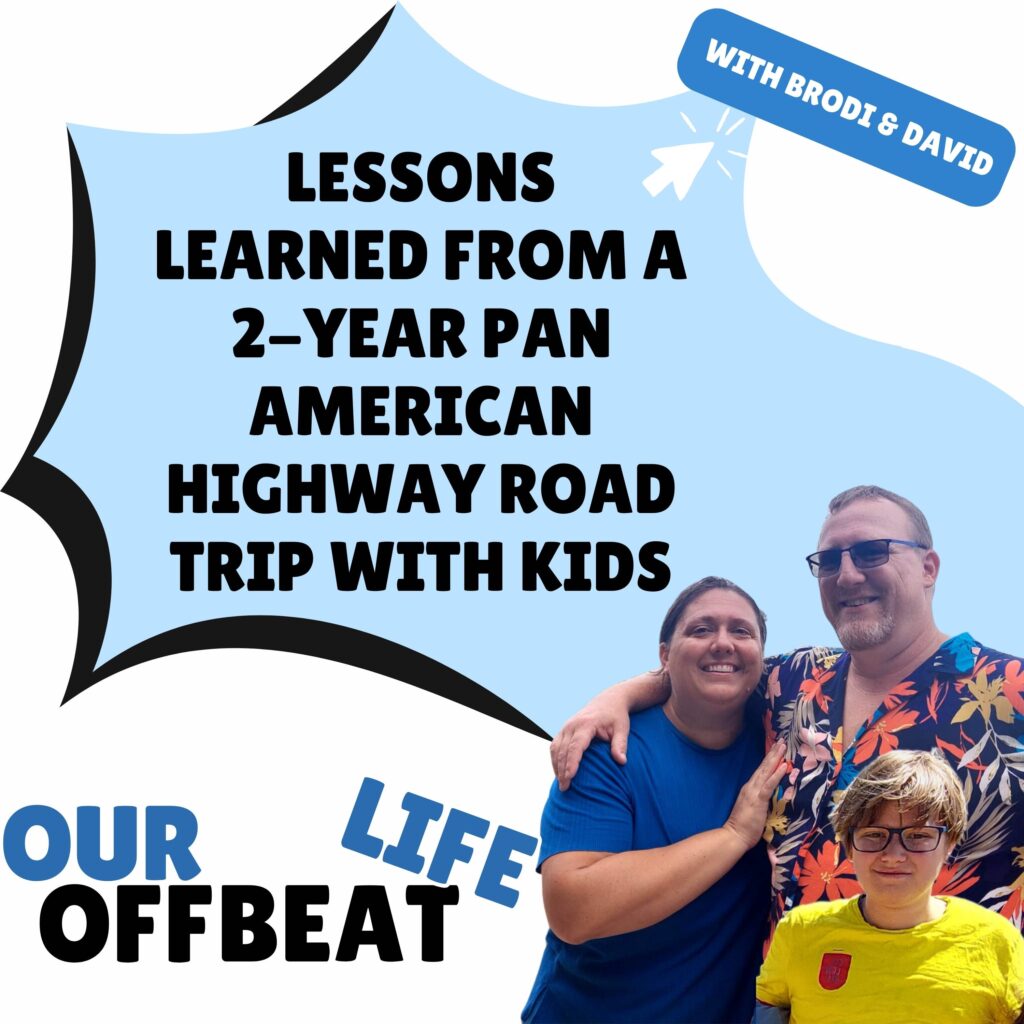
Have you ever dreamed of packing up your family and driving from the USA to Argentina? We made this dream a reality by road tripping the entire Pan American Highway with our young son over the course of 2 years.
Their journey is truly inspiring for anyone considering long-term travel with kids. In this transcript from our YouTube live stream, we discuss our motivation, logistics, favorite places, challenges, and top tips for an epic pan American highway road trip with family.
The Inspiration
Our travel adventure started unexpectedly when we borrowed a friend’s car during a visit to the US. Discovering our love for road trips, we decided to purchase our own vehicle and drive from North to South America.
After research, we bought a used 2003 Toyota 4Runner for its reliable reputation. Equipped with necessities like a roof storage pod, we were ready to hit the open road. Our plan: start in Mexico and drive as far as possible.
The Route and Itinerary
Over the course of 2 years, we drove our 4Runner from the US all the way to Ushuaia at the southern tip of Argentina. We took their time exploring, hiking, and experiencing local culture along the way.
Our route stuck mainly to the official Pan American Highway system through Mexico, Central America, and South America. However, we frequently deviated to visit off-the-beaten-path gems not directly along the highway.
Road conditions ranged from smooth, paved highways to rocky, muddy paths. Navigating unreliable Google Maps directions proved challenging at times. But the diversity of scenery and experiences made it all worthwhile.
The Ups and Downs
Like any adventure, the trip had its fair share of ups and downs. Challenges included police stops asking for bribes, car issues like flat tires, and massive landslides blocking the road.
Our biggest scare came when a road collapsed underneath our front wheel in Ecuador. Thankfully, overlanding friends came to our rescue!
However, we never felt unsafe in Central or South America. Seeing armed police and military provided an initial shock compared to the US, but ultimately increased our sense of security.
Among our favorite stops were the hot springs at Grutas Tolantongo (Mexico), sloth-spotting in Manuel Antonio (Costa Rica), sandboarding in Huacachina (Peru), stargazing in the Atacama Desert (Chile), and glaciers and penguins in Argentina.
The diversity of experiences was truly incredible.
Less favorable stops included living full-time in tourism-centric Playa del Carmen, Mexico and touristy Bocas del Toro, Panama. This reinforced the difference between visiting and living long-term in a frenetic place.
Logistics and Lodging
We worked remotely along our journey, emphasizing the digital nomad lifestyle. Most lodging consisted of house sitting assignments traded for pet care. This allowed us to stay in local homes and get furry critter time.
We also utilized Airbnbs and hotels with reliable WiFi for productivity. Shipping our car from Panama to Colombia helped avoid the dangerous Darién Gap jungle. Overall, costs ranged $2,500-$3,000 USD per month including gas, lodging and food.
Tips for Family Travel on the Pan American Highway
Based on their 2-year road trip, here are our top tips for traveling the Pan American Highway with kids:
– Take it slow and don’t overload your daily driving schedule. Stop frequently for kids to run around.
– Focus on experiential activities like hiking, wildlife viewing, and exploring ruins rather than passive entertainment.
– Consider house sitting or longer stays in furnished rentals versus constant hotel hopping.
– Learn key Spanish phrases, but don’t stress about fluency. People help you figure it out.
– Accept that things like Google Maps may be inaccurate in rural areas. Go with the flow when plans change.
– Avoid paying police bribes by insisting on taking paperwork to the station instead of cash on the spot.
Conclusion
Our journey along the Pan American Highway with our son shows that full-time family travel is an attainable goal. With research, planning, and embracing flexibility, your family can have an epic road trip adventure.
What stuck out to you from our lessons learned? Would you attempt a similar Pan American highway road trip?
Leave a Review!
Apple Podcast reviews are one of THE most important factors for podcasts. If you enjoy the show please take a second to leave the show a review on Apple Podcasts!
✔️ Click this link: Leave a review on Apple Podcasts
✔️ Hit “Listen On Apple Podcast” in the middle next to the picture.
✔️ In iTunes, Click “Ratings and Reviews” under the show name.
✔️ Leave an honest review.
✔️ You’re awesome!
Key Takeaways and Timestamps
Inspiration to Road Trip the Americas (00:00:37)
- Got the idea from borrowing a friend’s car while visiting the US
- Wanted a reliable vehicle with lodging space and internet connectivity
- Settled on a used 2003 Toyota 4Runner and outfitted it for travel
Working Remotely While Traveling (00:03:39)
- Both run location independent online businesses from the road
- David teaches online and runs a site for digital nomad teachers
- Brodi blogs about family travel and offers consulting services
Favorite Stops (00:29:36)
- David – Hot springs in Mexico, sloths in Costa Rica, sandboarding in Peru, Patagonian glaciers
- Brodi – Antigua, Guatemala; Monteverde cloud forest in Costa Rica; Las Lajas Cathedral in Colombia
Lodging Strategies (00:16:55)
- 50-60% of nights house sitting in exchange for pet care
- Hotels or furnished rentals with reliable WiFi otherwise
- Average monthly costs around $2500-$3000 USD
Border Crossings and Shipping Logistics (00:45:12)
- Shipped vehicle from Panama to Colombia to avoid dangerous Darién Gap
- Renewed docs and got mandatory insurance when required
Tips for Family Travelers (00:44:06)
- Drive short distances each day
- Focus on experiential activities, not passive entertainment
- Consider longer-term accommodations over hotel hopping
- Learn basic Spanish phrases
Transcript: We Drove To The End Of The World (Questions Answered)
[00:00:00] David: We did our drive from the US all the way down to Ushuaia, the southernmost tip of South America in just about two years.
[00:00:13] David: So, this live stream is really just to kind of give a chance for people to hear how we did that. Why we did that answer some questions for those that are out there that are really curious about that. So a lot of folks posted their questions in advance and that’s great. So we’ve got those questions and we’re going to kind of go through them one by one here.
[00:00:37] David: Now let’s look at our inspiration. So one of the paramount questions that people ask is, what was our inspiration? Well, when we first started this, it was just after getting back to, North America. after Malaysia, after we ended up
[00:00:56] David: having to leave Malaysia. We talked a lot about that on our first episode So if you’re curious about that, you can go back and listen to that, but we were staying with a friend, you know, who you are, uh, in the U S for the holidays and she let’s borrow her car to drive around since we were there for a couple of months.
[00:01:16] David: And we really loved it. We went to the Grand Canyon. We went to Horseshoe Bend and saw some really cool things. And so this is kind of a thing that can happen. this could be good. So we decided that we would find a vehicle that works for us. So what we ended up doing is we found, that we were looking at going towards campers and vans and converting this and doing that, but we needed the internet.
[00:01:52] David: I work primarily online, which kind of moves towards another one of the questions. how do we support ourselves? So I work online, so I need reliable internet and can’t quite get that in an RV. Starlink was. Around back then, but quite expensive. It’s gotten a lot more affordable. We’ve met a lot more folks with it now But it was out of our price range at the time.
[00:02:16] David: So we decided we needed to have a lifestyle where we could house it and airbnb and hotel and just find places that actually had internet reliable And that we knew where we were going to have that reliable internet in advance And so that kind of brought us to finding a reliable vehicle. And Brodi had always heard that Toyotas were very reliable.
[00:02:44] David: So she did a lot of research while we were in Nevada at our friend’s place and We checked out a bunch of different cars until we found this one,
[00:02:55] David: yeah, basically that’s how we’ve ended up with our vehicle. and then, we decided to, you know. Hit the road and start with Mexico since we’d already been living there for a while. We had an apartment in Playa and Nevada is on the opposite coast, basically. So we can see how we like driving across Mexico.
[00:03:16] David: We started with that drive, finished out our lease and, decided that we would, continue on until we couldn’t continue anymore.
[00:03:25] Brodi: And we’re still going.
[00:03:28] David:
[00:03:28] Brodi: So, one of the other questions we received is, How did you take two years off from work? And the quick answer is we didn’t.
[00:03:39] Brodi: David and I both have online businesses that we run. I have Our Offbeat Life, the family travel blog, which, you know, is mostly a website, but we also have our social media channels, Instagram, TikTok, Facebook, and David, launched the YouTube channel here, earlier this year. So, because sometimes you just can’t share everything you want to share in written form.
[00:04:08] Brodi: I’ve learned that. I’ve accepted that. so, yeah, and then on top of that, David also has his own website. it’s called the Tutor Resource. It is an online platform that offers resources and mentorship for online teachers and digital nomads, because that’s what we know, because in addition to the Tutor Resource.
[00:04:31] Brodi: David is also an online teacher himself, so he can mentor people in, what he is an expert in. And then, oh, he’s making faces at me. I have to tell you about my other venture that is part of Our Offbeat Life, which is our travel consulting, arm of our blog. Okay, it’s really just me. Essentially a travel consultant is not a travel agent.
[00:05:01] Brodi: I don’t do bookings for people and I am not a coach. I am not going to help you struggle through tough. Problems to find your own solutions, I am a consultant that will give you the answers. You are looking for the answers. You need the answers. You want to a variety of travel related topics from becoming a digital nomad to remote work because I do have a background in human resources.
[00:05:33] Brodi: to how to downsize your entire home, to become a world schooler or a digital nomad, because not only did I downsize our 2 bedroom apartment in Chicago before we left, but I also downsized. we had 2 Airbnbs. That we were running in Chicago at the time as well, because we lived in a three flat building and lived in one and rented out the other two on Airbnb.
[00:06:00] Brodi: So, I have travel expertise beyond just what things to do are there in Riviera Maya, Mexico. But I can also help with those types of logistics questions too. So that is something, that we can drop the link in the chat at some point if that is something that interests you. I’m happy to chat about that, but that is not what this video is about, but it is how we make our money.
[00:06:24] Brodi: So that is the answer to that question. and what about car maintenance? Do you want to talk about car maintenance?
[00:06:32] David: Yeah, let’s chat a little bit about car maintenance because a lot of folks in the… the groups were asking about how we take care of the car. what happens if it breaks down and things like that?
[00:06:44] David: Well, we found that with the Toyota, first off, it doesn’t break down very often. It’s actually a very reliable vehicle. I mean, really the only thing we maintain is our oil. We check the fluids everywhere we go, tire pressure if we need to, but. that’s it. we went from, what, we got an oil change in Mexico, we got another one in Mexico City, and then we didn’t need one until, what, Ecuador.
[00:07:13] David: I mean, we just kept moving and moving and moving and moving.
[00:07:15] Brodi: I love you. No, that’s wrong. I love you, Guatemala. Guatemala City. Yep. We got an oil change. we got another oil change in Panama City before we left because we didn’t want bad oil. That’s right. And then we got another oil change in Colombia.
[00:07:32] David: All right. So they all blend together because for me, they don’t, I don’t really think about it very often because of the fact that it, it’s just as easy. It’s just as simple as it is in the U. S. You go down, they take care of you, and the only time I’ve ever had a problem is when we were in Mendoza, Argentina.
[00:07:51] David: And they, they said they couldn’t change it because they didn’t have an oil filter. they didn’t have a correct one. And, we weren’t very far from Chile. They told us just to go to Chile and we could be fine. But they were, they couldn’t import it. We found out later from in Chile that that was not necessarily the case.
[00:08:11] David: because it takes the same kind of oil filter as many very, very popular vehicles down here like the Toyota Helix, which Brodi has now fallen in love with.
[00:08:20] Brodi: Gosh, I’m obsessed with this truck. I don’t even know why. I’ve never been a truck person ever. But the Helix is basically a smaller, but still as powerful version of the Toyota Tacoma.
[00:08:34] Brodi: and… The rumors are that Toyota won’t sell the Hilux in the U. S., not because it can’t pass inspection, but because it would… Easily outsell the Tacoma. And it’s a smaller version at a lower price point, and they like the money that they make on the, so, for those of you who are Toyota truck fans, the Helix is amazing.
[00:09:02] Brodi: I want one. And that’s just what, and
[00:09:04] David: that’s just what we’ve heard from people.
[00:09:06] David: Oh, total rumors. I have no idea if that’s true. Like. I that could be wrong. It probably is wrong, but that’s what people don’t hear. Think is that the helix is like to be all in and all the Toyota trucks Other than that, though, for if maintenance is concerned, we haven’t had any issues with the vehicle. We changed the tires when we were in Argentina as well and had to have some. yeah, only two, only two, yeah, two of the front two tires. We had them rotated a few times here and there, but the tires were too low of a condition, so really, that’s it.
[00:09:46] David: and, as far as I can tell, that’s actually doing pretty well. I think it’s a very, very reliable vehicle.
[00:09:54] Brodi: Yeah, it’s, it’s been a great vehicle. It’s definitely a great choice. I’m really glad that we chose it. it’s, it’s even comfortable to sit in for hours and end. So I think it’s a win all around.
[00:10:05] Brodi: the next question was about car registration. Do you want me to handle that one? Yes. Okay. So the question was, how do you handle your car’s registration? And the quick answer is I just pay it online and it’s been stayed renewed because our car is 20 years old. It’s a 2003. So the registration for us is really cheap.
[00:10:27] Brodi: it’s like 80 a year, I think. or a hundred dollars a year. Like it’s really cheap. So, our car is registered in Nevada. I just pay the registration. And I got the original documents when we originally registered it and my friend that let us use her. Address. thank you. I really appreciate it.
[00:10:48] Brodi: basically, like, gets the paperwork is hanging onto it until we get back for sure. I’ll never need it. But, so the stuff is mailed to her house and then she just shoves it in an envelope and for us for later, but we don’t. Like nobody cares down here about your registration stickers. We just took the stickers off of our license plate and I got a reprint of the registration document online.
[00:11:16] Brodi: I paid like 5 extra for this registration document and it like doesn’t have the dates on it. I don’t know how, but it doesn’t. So I just have those pronounced and when we get to borders. And they need to see our title and our registration. We own the car. We bought it cash flat out when we left. So the title is in our name.
[00:11:38] Brodi: we have the original title that we travel with, and then I have the registration document. That I printed offline and I have copies of all that and I just show them the copies at the borders and they don’t really seem to care. I mean, Mexico cared. They really did. We had to show originals of everything and have like two copies of everything in triplicate.
[00:11:58] Brodi: It was a little bananas. Central America loves their photocopies. South America could care less. We have not needed any of the photocopies since we got to South America. They just want to see something. They enter, there stuff in their computers, they’re good to go. It’s awesome. So yeah, I mean, some people let their registration lapse, when they leave the U.
[00:12:18] Brodi: S. and then they re up it when they get back. I couldn’t figure out what Nevada’s policy was on that sort of thing, and I didn’t want to have trouble when we do take the car back to the U. S. Some day, so I’ve been paying it, but again, our registration is really cheap. So, I mean, if we were driving like a 2022 Mercedes Sprinter conversion, that was worth like half a million and our registration was like 500.
[00:12:44] Brodi: I’d probably be a little bit more cavalier about it, but it’s just something easy for us to keep up. Okay, so that is registration. I renew it for peace of mind, not because I probably have to. the next question is what route did we take? Do you want me to take that or do you want me to take that?
[00:13:02] David: Yeah, we took the, we took the Pan American Highway, most of the way. We’ve gone off of it for some of the cool sights, but for the most part, we stayed on the Pan American Highway. There’s also been a few hiccups that got in the way, we’ll get into that. and, we will share on some of the social media platforms a video for those of you who are interested that Brodi made showing the whole route.
[00:13:31] Brodi: Don’t you worry. but one thing I will say is the Pan American Highway is a lot more a destination opportunity experience than it is driving on the highway itself. Most of the really good stuff is not on the official Pan American Highway. So, I mean, if we had just driven the highway, we could have been done.
[00:13:56] Brodi: What, three months, but it’s a lot more fun to explore everything around us. and that’s what we’ve been doing. So, I think I just want to throw this in here. Google Maps is awful. south of like the U. S. and Mexico, there’s so many times that it’s told us turn left, turn right, and it’s been A field or a canyon or a river or nothing, you know, a house.
[00:14:24] Brodi: So we then had to drive around it. So we figured out that Google is wrong a fair amount of the time when we like, you know, say, look up a restaurant to go eat at that restaurant may or may not exist. that started in Mexico where we would have restaurants that haven’t existed in like a long time. Like it said, there was a pizza restaurant and it turned out to be like.
[00:14:46] Brodi: A housing complex that was built like four years before. So the further south we’ve gone, the more often that’s happened. or places that we see like really good restaurants that we’ve really loved don’t even exist on Google maps. No one knows about them. They just don’t. So, you know, it’s just one of those weird things that you can’t count on Google to get you where you want to go.
[00:15:10] Brodi: More than about maybe 60 percent of the time anything you want to add.
[00:15:15] David: no, I don’t want to add to that I mean Google we still is our go to because everybody sends you the pins Everywhere you go. Even the people who’ve told us Wayz is what we use here, which is occasionally The places they always send pins Are in Google Maps.
[00:15:33] David: So you still end up using Google Maps quite a bit. There’s also some offline maps that we’ve used occasionally here and there, which will tell you if it’s a dirt road that you’re going to be finding or what it is that you can plan for. So, yeah,
[00:15:46] Brodi: so, but we find most often we’ll use. We always download offline maps before we drive, because more often than not, especially in the southern part of South America, once you leave a city, you’re not going to have cell phone reception again until you get to the next town or the next city, and sometimes not even in the towns.
[00:16:06] Brodi: so it’s just one of those, just one of those things, like, there’s not a lot of people living between the towns. And cities, especially in Argentina and Chile, the, you know, we can go hours without seeing another car or another human, um, lots of wildlife, but not a lot of people sometimes. So, yeah, it’s just, it’s just one of those things Google offline maps has been a lifesaver for us.
[00:16:34] Brodi: So that’s maps. I’m going to move on to the next question.
[00:16:38] David: Yeah, The next question really is, where,
[00:16:41] Brodi: where did you stay? Yes. Where did you stay? Do you want me to take that one?
[00:16:45] David: Where did you stay? Okay. so we stayed in a variety of places. I mentioned this briefly earlier. we’ve done Airbnb, hotels.
[00:16:55] David: but our biggest thing is house sitting. we love house sitting. It’s a great chance for us to enjoy places that we might not have seen before. the people’s houses that we stay at always have amazing pets, which then gives us our animal time. So since we can’t have a pet ourselves as easily while traveling, some people do, it just makes it easier so that our son, us, we can get snuggle time in with a variety of different animals.
[00:17:24] David: we’ve house sat for everything from dogs and cats to chickens and horses. so, so I love house sitting. I think about central America, about 50, 60 percent of our time. There was house sitting South America. It’s been what? 20%.
[00:17:41] Brodi: we spent about almost seven months in. Central America and Mexico house sitting.
[00:17:48] Brodi: And then we spend about four months this year house sitting. So it’s been less, um, if we were more flexible about where we were willing to go, like if we weren’t on. A specific route, then we probably could have gotten more house sits, but, you know, 4 months of house sitting is actually pretty good.
[00:18:09] Brodi: Considering how stringent we were with when and where we needed to be places. So, because we really needed to be in San Carlos de Bariloche, Argentina before the end of ski season. So that we kind of had to hurry a little bit more than I think other people would have. It was totally worth it. yeah, yeah.
[00:18:28] David: So, but then we also have done, Airbnb’s and hotels and Brodi has gotten very good at communicating and getting speed tests. from these Airbnb hosts and stuff like that to make sure that it meets what we need for work.
[00:18:46] Brodi: And it’s worked out. I mean, if you are wondering, can I live and work remotely in South America as a digital nomad? The answer is absolutely yes. We have not been to a single. Country where we have not been able to work.
[00:19:05] Brodi: So the internet down here is fine. And we booked this place like literally the day before we got here, we had very few options and all of the options we had to choose from still had fine internet. So it’s, it’s been fine. next question.
[00:19:21] David: All right. So the next question, it really comes back down to how, how much did it cost?
[00:19:31] David: Our lifestyle is. Really? Okay. So, to be completely transparent, we live a lifestyle just like we would if we were in the U. S. We work, we play. We work, we play. So, I work part time hours, you would say, for my teaching job. And then I have my other stuff on top of that. So, it comes out to being a full time type job and work hours.
[00:19:57] David: It’s just I’m more flexible about when I go and do things and when I’m actually on the computer working. same thing for Brodi. So our costs come about three grand a month to 2500 to three grand a month all in all. that’s gas, lodging, food, everything. that’s the type of thing. What else do you want
[00:20:18] David: to add to that?
[00:20:18] Brodi: well, there’s a couple exceptions to that. one that does not include what we spent on shipping our car from Panama to Columbia. That was a separate expense that we did budget ahead for. That was about 15, 1, 800, I think. I have to go back and look at it. 1, 800. I think so. and then also the month that we spent in Cusco, Peru.
[00:20:44] Brodi: Was more expensive because we went to Machu Picchu and even though we planned our entire trip ourselves, we did not use a tour company. we did hire a guide to meet us on site, but that whole day excursion was for the 3 of us, including trains and entry fees. And that stuff was a little over 500. So that kind of blew our budget in Cusco, but we knew that and it was something that we were willing to do.
[00:21:19] Brodi: So that was, those are probably the two major costs. And then, skiing in San Carlos de Bariloche. That was another month that was a little more expensive. but again, those are things that we plan for and things that we budget for. So it, it all pretty much works out and I don’t know if I had to budget all of those in, it would probably still only take us up to like 3,500 or 4,000 a month to average it out with all of the shipping.
[00:21:46] Brodi: But like, that’s a one off cost. Like, you’re not going to be shipping your car every couple of months. That’s just once in 2 years. We’ve done that. So there’s that. next question. did we have insurance? Do you want me to talk about that one or do you want to talk about that one?
[00:21:59] David: Well, that’s a you question.
[00:22:01] Brodi: Okay, that’s a me question. So I’ll keep talking. Did we have insurance? And also, did you need to use it? So, we… Do not U. S. insurance doesn’t work outside the U. S. so we buy mandatory 3rd party liability insurance whenever we are required to do. So, in Mexico, we were required to, throughout, let’s see the rest of Central America.
[00:22:29] Brodi: We only had to do that again in Costa Rica and Panama. So. Those were the other 2 there and then Colombia. We needed it. Ecuador. We didn’t, Peru. We did. And then, Argentina and Chile. We have needed it. So we buy it when we need to when we knew we were entering Chile. There’s actually. A joint multinational insurance plan you can buy called Mercosur so it covers us in Chile, Argentina, Bolivia, Paraguay, Uruguay.
[00:23:07] Brodi: I think that might be it. so we basically bought like a nine month plan so that that would take us through some time in March. and then we can just renew it from there. If and when we decide that, you know, we want to keep exploring more in South America. So we have never needed to use the insurance.
[00:23:26] Brodi: I don’t really think we’ll ever need to, unless somebody crashes into us. because third party liability insurance doesn’t really cover much. It’s not comprehensive coverage. There is no such thing as comprehensive coverage anywhere in Mexico, Central America, or South America. It just doesn’t exist for foreigners.
[00:23:46] Brodi: So there’s not really a point in buying extra insurance because. It’s not really a thing. so safety issues. Do you want to talk about safety issues? the question was, did you have any safety issues, bribes, et cetera, anything like that? So do you want to talk about that?
[00:24:06] David: Well, as far as safety is concerned, you’re always aware.
[00:24:12] David: I’m going to preface everything I say with, we come from Chicago. we lived there for 16 years. So, and we lived in downtown, we lived in Humboldt Park, we lived in Ukrainian village, and we’ve lived all over. the city. so we are very comfortable with, with the city life. So when we go someplace,we are fairly comfortable.
[00:24:35] David: We’re fairly aware of our surroundings. And I have not… really felt uncomfortable, most places. there was an annoyance in Nicaragua where we kept getting pulled over, mainly on this one stretch of road, four or five different times. And we just felt like we had enough and it was just trying to get a bribe for the most part.
[00:25:04] David: we didn’t end up paying anything. We don’t believe in doing that. So we just stall, Uh, until they give up and they let you go. you can talk about that too.
[00:25:15] Brodi: Okay, so there’s two schools of thought. With Overlanders about paying bribes. one group says just pay ’em because it’s easier and faster. that is a minority and quite frankly, it’s wrong.
[00:25:29] Brodi: the people who say that are wrong, don’t do that. you don’t have to pay bribes. All you have to do is sit, you have to sit there and play the waiting game. Yes, it takes longer. We have never sat longer than 15 minutes. 10, 15 minutes. Would you say, um, waiting and basically, you know, you can, if you don’t know Spanish, fine, if you do know Spanish, pretend you don’t speak to them entirely in English.
[00:25:57] Brodi: they will get frustrated with you occasionally. Once we had somebody who got fancy and pulled out his phone to Google translate with us and but you have to know your rights. Your rights are you do not have to pay the ticket on the spot. That is a moredida. That is a bribe. It is not legal. You should not do it.
[00:26:19] Brodi: Do not. That’s what we were told and that’s what we go with. So, if somebody wants to tell us, either they know English or they pull up their Google translate that we can pay the ticket on the spot. We say, no, we only take the paper ticket. We will go to the police station and pay the ticket. That that’s the best way to get around it.
[00:26:39] Brodi: So, you know, that’s, it’s worked for us every single time you just wait for them to give you the paper ticket and then they aren’t going to give you a paper ticket because nine and a half times out of 10, you didn’t actually do anything wrong. And then they let you go. That’s worked for us in Nicaragua, the 4 or 5 times we got pulled over in like an hour and a half.
[00:27:02] Brodi: It worked for us the one time in Mexico that we got pulled over. and it worked for us the one time in Peru that we got pulled over. it’s, it’s not really been an issue. We haven’t had it happen a ton. We’ve gotten pulled over a lot more than that for, by like military for traffic stops. Like we got every time we went through a toll in Mexico, we had to stop and talk to the military and show them our car papers.
[00:27:28] Brodi: Not a big deal. You show them the papers. They look at them. They see they’re not expired. You’re on your way. But if they’re expired trouble, your car is going to be impounded and you will never get it back. So that’s that.
[00:27:41] David: And the only other thing to say that I have to say about that is. we have also gotten used to, to seeing big guns,
[00:27:48] David: uh, because mainly just the military and the police, they carry their guns very big, very plain to see, um, in the U S it’s a lot different not to be political or anything, but the hidden carry scares me more than. What I see traveling around Central and South America, it’s not as big here in South America as it was in Central America, where there are guards and Guatemala city all over protecting and keeping everybody safe.
[00:28:20] David: So I didn’t feel. Unsafe there at all, because those guards were there really helping, and things like that. So, do you have anything that, how did you feel?
[00:28:31] Brodi: No, I actually didn’t like, you know, you’d walk into a bank to go to the ATM and there would be guards. With big guns in South America, there’s guards and they may or may not have big guns.
[00:28:45] Brodi: They may have smaller guns. They may have no guns, but there’s definitely like, there’s still guards, but that’s no different than the U S there’s guards at the bank. Like it didn’t feel any different. no, I honestly, I don’t think I’ve ever felt more unsafe anywhere on our Latin American road trip. I don’t know.
[00:29:06] Brodi: I just, maybe it’s a perception of safety, but if you even look at the statistics, most U. S. cities are less safe statistically than any country anywhere in Latin America. So, between the statistics and my personal experience. I would have no problem going anywhere, again, anywhere on our trip.
[00:29:27] David: Agreed. Okay.
[00:29:28] David: Moving on to something more fun. Yes. We had a lot of questions from people asking about our favorite stops, our top fives, and all
[00:29:36] Brodi: that kind of thing. This is going to be really hard. yeah. So, do you want to go first?
[00:29:40] David: my favorites…
[00:29:42] David: Really come back to you like Grutas Tolentongo, Mexico, which have amazing hot springs. again, I showed some pictures and shared some stuff about that in our first podcast episode. another place I really, really loved was Manuel Antonio areas in Costa Rica where I saw my first sloth. and did some really cool hikes. Then Huacachina in Peru, where I got to do sandboarding.
[00:30:10] David: those are my top, top, top. and then lately, I want to let Brodi go, but I have to say, and she’s probably going to agree with me on the last one, which is this really cool glacier that we saw. But, let’s see what she says.
[00:30:23] Brodi: Totally agree about the Glacier, but I really enjoyed Guatemala, going to Hobbitenango and the whole area in and around Antigua, Guatemala was just amazing.
[00:30:36] Brodi: I, I would love to go back and spend a month and just keep exploring and relaxing. I did enjoy Manuel Antonio in Costa Rica, but I really love Monteverde because. I’m a sucker for cloud forest because it’s a shrinking habitat around the world, like, less than 12 percent of the entire globe right now is cloud forest and they are a vanishing ecosystem.
[00:31:01] Brodi: And I just. I love them and I love Monteverde. I was there in college with one of my favorite professors and some really good friends. and it’s just, it’s always been a special place for me. Columbia was amazing. Medellín was lovely. I got to go to the Las Lajas Cathedral, which is a like French Gothic style cathedral that looks straight out of Beauty and the Beast.
[00:31:27] Brodi: on the side of this. monstrous canyon with a flowing river and it’s covered in green. It’s gorgeous. Like I, it’s been on my bucket list for at least a decade and a half, maybe two decades. Like it’s been a long time. I’ve wanted to see it. So that was really exciting. seeing the Nazca lines, my bucket list, Machu Picchu, Machu Picchu was magical.
[00:31:50] Brodi: Like there’s just something about that place. I know it’s touristy. I know it’s expensive, but for me it was worth every penny. I don’t know. I mean, we both, I think, really enjoyed, um, sky watching in San Pedro de Atacama, the desert, like, it is the world, like, literally, it’s a desert where, like. Parts of it.
[00:32:12] Brodi: I’ve never received a drop of rain ever. Like you literally like you get there and your skin just shrivels up and you need moisturizer like four times a day, but it’s amazing. And the sky, it is the darkest blackest sky I think I’ve ever seen. I’ve never ever had star watching be that amazing. It is just, it is one of the best dark sky gazing places in the world, like renowned for this.
[00:32:41] Brodi: And for good reason. It was amazing. I don’t know. I could keep talking about all the places. They’re amazing.
[00:32:46] David: There’s so many. And like, if you get a chance to drive, definitely drive the Carretera Austral. we did it. And it took us, what, four days, uh, five days. but we took our time or we could have gone even slower and seen it.
[00:33:06] Brodi: I could have spent two weeks doing it, honestly.
[00:33:08] David: Yeah, it was just some of the best, most beautiful sites. I kept pulling us over. I’m already a sucker for any pull off. I have been since growing up traveling. I mean, that’s what we did. We stopped off at all these stop offs, miradors everywhere. So I love that type of thing.
[00:33:25] David: And if you love that type of thing, you would like the Carretera Astral.
[00:33:29] Brodi: Okay. So changing gears from happy thoughts back to not so great things. Another question we got was What were your biggest letdowns? and there were not a lot. I mean, we really had to like dig into this one.
[00:33:46] Brodi: So I’m glad, I’m glad someone sent us this one in advance because it was tough. But the first one we came up with was living in Playa Del Carmen. living in Playa Del Carmen was. Not great, but not because Playa del Carmen isn’t great because before we became digital nomads, we were vacationing there like once a year, once every other year, like we, we, we had been multiple times.
[00:34:17] Brodi: That’s part of the reason, that when we came back to the Americas from Asia in 2021, we set up a temporary home base there. because we just, we knew it and we were comfortable with it, but living there is different and you never get away from tourism, like ever. It is an amazing place to vacation.
[00:34:41] Brodi: And everyone knows this. We
[00:34:42] David: even lived, Not in the downtown touristy areas, you know, get away from a little bit of that great food. Love it. Love it. Love it. Miss it. Miss it. Miss it.
[00:34:52] Brodi: I do miss some restaurants there. Yeah,
[00:34:54] David: but yeah, you can’t get away from the tourism. staying year round. You see the different weather patterns and it’s.
[00:35:00] David: Really bad summers,
[00:35:02] Brodi: really hot. I mean, we lived through a hurricane, not something I want to repeat. Like, and then there’s the seaweed season. Like there’s many things to love about Playa del Carmen. That’s why I have a whole blog section dedicated to how amazing it is, but like. Living there is different and I will continue to vacation there.
[00:35:20] Brodi: I won’t live there again. just personal preference the other one would probably be Nicaragua, yeah, mostly because the police stops are so frequent and we just felt like walking banks like And I wanted something from us
[00:35:35] David: in our twenties. It was a different story. Was that our thirties? late twenties.
[00:35:39] David: I think that’s right. And that was a different story. We had a blast. but dry and we weren’t driving it then. No, but driving it not my thing,
[00:35:48] Brodi: but it also could be because post pandemic. the unemployment rate in the entire country of Nicaragua exceeds 70%. They have struggled so much in, in, during, and since the pandemic started.
[00:36:07] Brodi: And it’s heartbreaking. And so it just like, we woke up at sunrise to like, to walk in Granada one day to watch the sunrise. And this guy was jogging and he was like. You guys need to be careful. You shouldn’t be here watching the sunrise. It’s not safe for you. And I was like, it’s just like everywhere we went, it just it’s in your face and it was sad and it was devastating.
[00:36:31] Brodi: And, and we left early, so I’m sad that we had to, but it just was not, it was not a good place for us to be. It didn’t feel safe. Like we were constantly told by like local Nicaraguans, you shouldn’t be here. Like, this is not a safe space for you as tourists and tourist destinations. That’s not something.
[00:36:50] Brodi: You want to hear it? So we didn’t stay, I know there’s other people who love Nicaragua. We loved it too once, but we didn’t love it this last time. So,
[00:36:59] David: Finally, I would say Bocas de Toro was a beautiful location, but just a little bit of a letdown for us.
[00:37:08] Brodi: I didn’t like it at all. it was super expensive.
[00:37:12] Brodi: It was super overpriced for what it was. And it was really hard to get around. and we had several times where we had, water taxi drivers, yelling really racist things at each other. Like, so there’s, there’s just different groups, like there’s, you know, the local, like. Panamanian historical, like ethnic groups.
[00:37:40] Brodi: And then there’s the like Islander, like the, the, the Caribbean Islander ethnic groups that have come in and they’re like, to me, it’s a, it’s a beautiful merger of it, but they have serious problems with it. And we had one guy that like, they were just screaming horrible things at him and they didn’t think we knew Spanish, but we knew enough Spanish to know what they were saying.
[00:38:04] Brodi: And it was horrible. Like I, I was so uncomfortable, but I was also so sad for him that that’s his life. And that they would think that it’s acceptable to be so blatantly horrible to each other. It made me sad and it made me uncomfortable. I don’t, I don’t think that I would go back. again, I know people who’ve loved it and we just didn’t love it or I didn’t love it. But maybe you thought it was better than that, but I wouldn’t go back,
[00:38:30] David: but as of South America, nothing has been a letdown.
[00:38:33] Brodi: Nothing. Nothing has let me down in South America. So far. I, I, we, we, we, we
[00:38:39] David: sometimes complain internally about the driving in Lima, but even that,
[00:38:44] Brodi: but that wasn’t a letdown. We knew that going in and going in, it was going to be bad.
[00:38:49] Brodi: Lima is one of the worst cities in the world to drive in. it is what it is. but it wasn’t a letdown. I loved Lima for so many other reasons. We met some amazing people. We ate some amazing food. there’s amazing museums. It’s super kid friendly. There’s some great experiences for families. We just absolutely loved it.
[00:39:07] Brodi: so that’s letdowns. Let’s move on. Letdowns make me sad. Yeah. Oh, wait, great. The next one. We did not balance these conversations at all.
[00:39:13] David: Moving from letdowns into what obstacles?
[00:39:16] Brodi: What obstacles did you encounter? Landslides. That was really it. Landslides. Big ones. Big landslides.
[00:39:21] David: Well again, I will reference back to that first episode of the podcast for more detail on it. But we encountered a giant landslide that made us detour our route. By several days. By several days. there’s, there was always the… in the feeling that whenever we were driving that there could be a landslide because we would drive turn on a corner and there was a previous rock slide or the ground was covered in clay and dirt because they had just cleared one and it hadn’t rained since to wash away the remnants, or whatever
[00:40:00] Brodi: little rocks would tumble down as we drive past, like It’s just, it’s, it’s a constant anytime.
[00:40:06] David: It’s a South American thing down here.
[00:40:08] Brodi: It’s, it’s an Andy’s mountains thing for sure. Yeah. but yeah, like the only other thing would be when we were driving through one specific state in Northern Argentina, there were roadblocks. And we ended up sitting at a roadblock for like two hours until they opened it, but I never felt unsafe.
[00:40:30] Brodi: Like the people were really clear that they, it was a nonviolent political protest and they were really open and strategic about how they were implementing it. And so I completely respect what they said and what they were doing and the purpose behind it. And it was solely an inconvenience for us.
[00:40:49] David: And we had great conversations with those parked around us while we waited.
[00:40:53] Brodi: but yeah, we, we made the best of a situation and it went better than it could have. And yeah, that’s probably about it.
[00:41:03] David: and then we skipped Bolivia, because tourists, they don’t, they’re not able to get gas or if they are, it’s really expensive.
[00:41:14] David: In the cities, and it’s difficult to get to the ones in the, out, out of the cities as well. We’ve even had friends that are driving through there right now, and they’ve been complaining about it.
[00:41:25] Brodi: Turned away at the pump because they are foreigners, and they are not able to sell gas to them, not willing to sell gas to them.
[00:41:32] Brodi: We haven’t really figured it out, but it’s, it’s a known issue, and we just didn’t want to deal with it. So someday we will go back. And then we will explore Bolivia by bus, not driving it ourselves, that is our plan. So, what about, I mean I guess we’ve kind of already talked about that, like the scariest, most dangerous situation we’ve encountered, we haven’t really had any.
[00:41:56] Brodi: Except for that one car thing,
[00:41:58] David: the one time when we were in Ecuador after some rains, and the road collapsed underneath our front, front right wheel. And, yeah, we were sitting there. 45 degree angle or more.
[00:42:13] Brodi: You can watch the highlights reel on our Instagram. coincidentally, it’s one of our highest ever watched reels because, you know, people like watching distress people like watching distress.
[00:42:26] Brodi: everything was fine. Our car was not damaged. David took it to a mechanic guy who like fabricated a part and it was amazing. So it turned out really well. we had some overlanding friends who came to rescue us. I would like to do a special call out to our friends at Meet Around The World. Richie and Abigail, you guys are saints.
[00:42:47] Brodi: They literally stopped what they were doing. Drove half an hour, came and towed us out. and rescued us. So they are literally our saviors. our car will probably still be in that ditch. that was created when the road collapsed. I
[00:42:59] David: literally thought while we were, while I was sitting in the car for an hour at 45 degrees, she climbed out, the kids climbed out.
[00:43:08] Brodi: Oh yeah. We had little man’s friend with us. We were going to see an animal. We were going to an animal rescue to learn about condors. Coincidentally, we never made it to the rescue because the kids Wanted to give up and we took them for ice cream makes everything better
[00:43:23] David: So yeah, that was the only time I thought this journey was over Because I’m sitting there not knowing if this is going to come out or if I’m gonna flip the car before Our friend gets there after she finally got on the phone And thinking of ways, how can we use our slack lines that we have a hold of to try to solve this?
[00:43:43] David: situation And just thinking that if the car rolls And it’s totaled for some reason that, I mean, we don’t have the money to fix a car, buy a new car, and continue the journey right then and there. So we would have repositioned. But again, that didn’t happen. It wasn’t time for the journey to be over and we had amazing friends that came to the rescue
[00:44:06] Brodi: She did so it was a bad day that ended well And we were really lucky so hooray.
[00:44:15] David: That was the only scary moment.
[00:44:17] Brodi: I mean I was nervous on the Trampoline De La Muerte
[00:44:23] Brodi: The springboard of death, the death road in Columbia that we had to drive because of the landslide, but it ended up not being a big deal and actually was. An absolutely beautiful accidental experience that I don’t want to repeat, but I’m glad that it happened, and I’m glad that it’s over.
[00:44:40] David: That one was more of a buildup in our heads because of all the conversations in some of the groups.
[00:44:48] David: The government stepped up, making it one way every day, which made it passable.
[00:44:55] Brodi: Yeah. So. Yeah. I was super nervous about it, like, like, like anxiety, nervous, and then it was fine. So, but again, it was not a dangerous experience. It was just something I was nervous about.
[00:45:07] David: Another question that was submitted many times was how we got across the Darién Gap .
[00:45:12] Brodi: Yes. in any case, so we shipped our car around the Darien gap. we met some people in. I think that’s where I’m going to start the story.
[00:45:24] Brodi: So we met some people in Merida, Mexico, at a pop up, a meetup of other world’s schooling families, and they were driving the Pan American highway like us. And we were like, Oh, wouldn’t it be so funny if we ended up shipping our cars together? and they were like, Oh yeah, it’d be so funny. But then they passed us and they were ahead of us.
[00:45:47] Brodi: They were almost done with their six months in Mexico and we still had several months left. So I didn’t really think it would work out, but ultimately, fast forward, it did work out. So we had a lot of, a lot of luck. I think, we kind of just stayed in touch with them. And so instead of spending, you know, two months in Panama, like we planned, we ended up only spending a month.
[00:46:11] Brodi: But that’s okay. Like Panama is fun. We really enjoyed it, but I don’t feel regret that we cut short our time in Panama, to ship because in reality, if we had waited any longer, we would have run into major delays with, and price increases with, the Christmas holiday approaching. So we ended up shipping in early November instead of late November.
[00:46:35] Brodi: And that was absolutely the right choice for us. So, yeah, so we ended up shipping our car from Panama City to Cartagena, Colombia. and we ended up flying to Barranquilla, Colombia instead. It’s another city on the Atlantic coast. you may have heard of it because that’s actually where Shakira is from.
[00:47:04] Brodi: Shakira from Barranquilla. I think she says that in one of her songs. I think that’s where I keep getting that. So we flew to Barranquilla while we waited for our car to make its way to a new continent and we renewed little man’s passport. that was a whole nother adventure in itself. renewed his passport in Barranquilla and, um, yeah, and then we just made our way over to Cartagena to wait for our vehicle.
[00:47:36] Brodi: And that took about a week, I think, in total. And that was it. So, yeah, so we shipped our car from, Pasadarian Gap. We did not trudge through jungle. We did not drive through the jungle. It’s really boring, really boring flight. It was our only flight. so the last question that was submitted in advance by a friend of ours was what’s next.
[00:48:03] Brodi: Are you selling your car in Argentina, or are you driving it all the way back? So we’re definitely not driving back. Sorry, we’re not. I don’t want to drive through Nicaragua again right now. And there’s, you know, I had just like, we’ve done it. We’re good. so we, we still have more to explore. We’re going to be here in South America for at least sometime in spring of 2024.
[00:48:34] Brodi: no, we’re not sure. we have some plans. Some people are in on those plans. Some people are not. I’m sorry, but we’re not ready to go public with all of our plans yet. Stay tuned. So stay tuned. at some point, we do want to go Go back to Mexico and explore some more. We want to go to Asia and explore some more, but the details are still to be determined.
[00:48:58] Brodi: the best place to find out what we’re up to is on our email list. You can subscribe at our offbeatlife. com because. Our email list people always get the scoop on what is going on in our lives before the rest of y’all. and you know, but we do make announcements here and on social media, so you know, we’ll keep you guys posted.
[00:49:21] Brodi: We’re just not ready to be official about everything yet because we’re still working on some details. But we are not done traveling. We are not going back to the U. S. to settle down and get day jobs. And do all of those things again, we’re going to keep adventuring and I’m not sure where and when we’ll stop traveling.
[00:49:42] Brodi: I’m sure someday we’ll probably pause again. Do you have anything you want to add?
[00:49:48] David: No, kind of a bonus question. I’ve been asked before by people, would I consider settling down somewhere? There’s been a few places that I’ve seen that I wouldn’t mind. Like, I really want the nice, cool, comfortable weather.
[00:50:04] David: Not too hot, not too cold, not too buggy. You know, like the bugs. But, like, so, Ecuador was great for me in that regard. At least where we stayed in Cotacachi. It’s an amazing little
[00:50:16] Brodi: town. If you guys have not been to northern Ecuador, it’s amazing.
[00:50:19] David: It was the first time we’d actually heard English.
[00:50:24] David: in a long time. Which is just a bonus, you know. I mean, we’ve gotten used to trying to practice and pick up the language as we go. Being two years in Spanish speaking countries. But it was very nice to hear your native tongue quite a bit. as well as seeing all the locals. It was a lot of good culture there.
[00:50:42] David: it’s a short drive to some really cool activities. so it was just a really good place. So, so far in my opinion. Plus, all the roses were like, dirt cheap.
[00:50:52] Brodi: Oh my gosh, yeah. Look back on my, look back on, our Instagram for, yeah, pictures of me holding like, dozens and dozens of amazing roses that were like, a dollar a piece.
[00:51:04] Brodi: It was amazing. yeah, our house would smell like roses. Every day. If, if we lived there, so
[00:51:10] David: that would be for me. If I decided to settle down right now, for whatever reason, I would probably choose that.
[00:51:15] Brodi: Really? Okay, Mexico still high on my list because tacos and guacamole little man would live on guacamole.
[00:51:25] Brodi: If we let him still, like, that’s still one of his favorites. although I heard him tell his teacher and his online school today that his favorite thing about Argentina is the ice cream because. The ice cream is amazing. Yeah. It’s like Italian gelato amazing all the time, but it’s like a dollar 25 for like giant scoops of it.
[00:51:45] Brodi: It’s amazing.
[00:51:46] Brodi: So. Yeah, I think Mexico and Ecuador are definitely our top contenders if we did settle down in the Americas, but I’m just not ready to do that yet.
[00:51:57] Brodi: I’m just not there. I just want to keep adventuring and seeing more and, um, I can say that right after we leave, so we’re in Ushuaia now for one more week, And then we are driving to Buenos Aires.
[00:52:18] Brodi: I love it. I love it. yeah, we’ve been
[00:52:21] David: having a great time here in Tierra del Fuego. We were, we were at the
[00:52:26] Brodi: big park, Tierra del Fuego National Park. Yeah, we went yesterday for the day.
[00:52:31] David: And we were a whole day there on some of those hikes with our kids and our friends and their kids. And yes, this area is beautiful.
[00:52:41] Brodi: If you have never been to Ushuaia, you need to put it on your list. It is amazing. Just, I mean, just going to the mall and sitting at the food court, you get this gorgeous panoramic view of the Beagle Channel and the birds and the water and the snow capped mountains.
[00:53:05] Brodi: And it is just Unbelievable. You’re driving through town and there’s snow capped mountains everywhere and I would actually love to come back to Ushuaia and go skiing. There’s a chairlift over the road, you guys. Like, it is amazing. Like, I, I just think it’s so beautiful here and even the drive, the drive in is.
[00:53:30] Brodi: Fabulous.
[00:53:30] David: I would love to explore more here. I would love to go back to the park. with a birder. There are so many birds. Yes. And, different types.
[00:53:42] Brodi: A professional birding tour in Tiera Del Fuego National Park. Yeah. That would be amazing. I would love that.
[00:53:48] David: I hope to get some videos posted that I saw.
[00:53:51] David: We saw birds chasing each other. We did. We just love birds. Love geese that are always together. a hawk with the winds yesterday just flew up into our faces.
[00:54:02] Brodi: Like right in our faces. It was so cool. It was so cool.
[00:54:06] Brodi: When we drive back north and go to Buenos Aires.our drive up technically, I think we could make the drive in 5 days, but it’s probably going to take us like, 10 because we stop everywhere and like.
[00:54:19] David: There are some really cool things that we should, that we’re going to see while we’re out there.
[00:54:22] Brodi: Well, you guys will see the videos eventually. There’s some cool stuff. let’s just say they will, at some point you will see more wild penguins than the ones you saw, that I showed you in Chile and Peru. I, I love all the penguin things.
[00:54:33] David: Little man still has not had, not yet had to do his… Go to goal, which is eating, those hostess cupcakes that they call pinguinos down here with a penguin.
[00:54:42] Brodi: I, we love doing all of the outdoor and the hiking things, as long as they’re not too steep or difficult because, you know, hiking with kids is always something that’s, A little bit more difficult at times.
[00:54:56] David: again, folks that are listening. If you have other questions, shoot us an email or message on Facebook, Instagram, whatever your preferred.
[00:55:08] Brodi: Our email is hello at our offbeat life. com. So you can reach out to us there.
[00:55:15] Brodi: It’s been an amazing experience. I will say like, you know, not every minute of every day has been, you know, perfection, but. Overall, our drive has been fabulous. We’ve met some amazing people. We’ve seen beautiful scenery that just is incomparable to anything I’ve seen anywhere.
[00:55:44] Brodi: Like, not just the U. S., but, you know, Asia, Europe. I mean, South America, especially. Like, Argentina. Has been mind blowing and just gorgeous. I think Argentina is such an under rated country in terms of the people and the food. Our son would say the ice cream, he loves the ice cream, you know, and just the amazing things.
[00:56:15] Brodi: And it’s just, I feel so lucky that we have online jobs that will let us work anywhere there’s internet and give us the flexibility to take a break for a few days when we want to go see glaciers and 10, 000 plus year old cave paintings made by prehistorical humans. It’s been, it’s been fabulous.
[00:56:41] Brodi: How long have you been traveling? We’ve been traveling.
[00:56:44] David: For four and a half years,
[00:56:46] Brodi: yeah, we left Chicago in June of 2019 and we’re now Yeah, four and a half years is a lot. but we do it slow. You know, like, we’ll spend a month here, six weeks there. We’re in Ushuaia for two weeks.
[00:57:05] Brodi: So, yeah, I mean, we’ve been traveling for four and a half years, but we do it really slow. So that we can take advantage of, you know, not hurrying, but also it gives us time to work. So, you know, since we work online, so that it gives us a way to really experience the place.
[00:57:23] Brodi: you know, to really just see and do local things like go see a movie or take our son to the trampoline park if there is one. you know, that kind of stuff. So, yeah, it’s, it’s been an adventure and it’s been amazing and we’re really, we’re really fortunate to be able to do that.
[00:57:42] David: I was reminiscing the other day about how it feels like it’s over but it’s not, not just other travels. I mean, we, South America is almost done, but it’s not even driving up north and our plans, our tentative plans and whatnot is still we’re still got months on this journey. So.
[00:58:04] Brodi: Yeah, I, I totally, I totally get the feeling about wanting to do that.
[00:58:08] Brodi: It’s, it’s, it’s not something that everyone is able to do. I wish, I wish more people could do it. we’re just lucky enough that we’ve been able to create online work opportunities for ourselves. And, you know, we, we do have some stuff on our blog about, you know, helping people who want to branch into the digital nomad life, but.
[00:58:31] Brodi: It’s not it’s also not for everyone. It’s you know, there are challenges to living a transient lifestyle So
[00:58:38] David: it feels like the world is making it easier to find the online positions We’ve met people from all walks of life from stockbrokers to writers who found a way to make it work and If you if you put your mind to it, then you can find a way to make those types of dreams happen And find a way to live the life that you want to have while still being able to make some money.
[00:59:08] Brodi: Yeah, I mean, like even one of our friends that we met in Colombia, they’re Colombian, they are fluent in English. And work online for a Canadian company doing customer service. So, you know, they, they travel around mostly in Columbia because it’s more like a remote job. So they can’t really go totally nomadic, but, you know, they can definitely work remotely in within Colombia.
[00:59:41] Brodi: And so they, they’ve been traveling all around the country and exploring and. You know, doing a lot with that too. So, you know, it, it isn’t necessarily something that’s limited to North American individuals, but I definitely have seen more Europeans and North Americans than. People from other places who have become nomadic.
[01:00:06] Brodi: yeah, I don’t, but it is possible. We, our friend, our friend in Columbia is living proof that you can do that.
[01:00:14] David: So. To give you an idea of what we’ve talked about today, for those of you who couldn’t… joining, going back, we talked to everybody about our inspiration, our ups and downs, our favorite places, the fact that we have a Toyota 4Runner, that we made this whole journey.
[01:00:30] Brodi: A 20 year old Toyota 4Runner, I will add. We, it is a 2003 Toyota 4Runner. the
[01:00:40] David: 260, 000 miles are now on it as of reaching, Ushuaia.
[01:00:46] Brodi: So yeah, we, we definitely bought a seasoned vehicle for sure. it was, I don’t know, like when, when we told the people, this is funny when we told the people who were selling it, what we wanted to use it for, they thought we were crazy.
[01:01:06] Brodi: They like, They were like, I’m sorry, you want to do what with it? And I was like, oh yeah, we’re going to drive it to the southern tip of Argentina. And they were like, what? Are you sure? And it was funny because the people who sold it to us, he was a police officer in Las Vegas. And it was his wife’s car.
[01:01:31] Brodi: And they were only selling it because, he told her that the car was too old and he wanted her to get, like, a nicer, like, minivan or something. And so when we told them, we’re basically like buying these people’s junk cars so that we can drive it across two continents and they thought we were crazy.
[01:01:50] Brodi: We should send them a photo of our car at the Ushuaia sign and be like, we made it! And they’re going to be like, you people are crazy. I think we should do that. I think
[01:02:02] David: So, the last four years, we’ve been to a different continent. this year is going to be, Antarctica. For Christmas.
[01:02:11] Brodi: For Christmas.
[01:02:12] Brodi: Yeah. We realized in 2020, we spent in Asia for Christmas.
[01:02:21] Brodi: 2021. North America. We were in North America for Christmas. We were in Nevada. 2022, we were in South America because we We’re going to Columbia for Christmas. This year we’re going to be in Antarctica for Christmas. And I don’t know where we’re going to be next year, but it has to be either Australia, or Europe, or Africa.
[01:02:41] Brodi: Because those are the three continents we haven’t been to yet.
[01:02:43] David: Hehehehe. Yeah. So, yeah. It is. It’s crazy. It’s cool. It’s awesome. I’m excited. We’re loco, but.
[01:02:52] Brodi: We’re loco, aren’t we? That’s okay. I don’t want to be, I don’t want to be, normal anymore.
[01:02:57] David: I’ve always said normal is overrated.
[01:03:00] Brodi: I always said normal is the cycle on your washing machine, and it still varies by brand.
[01:03:06] Brodi: So thank you so much for joining us and for our silent viewers. Thank you so much for stopping in too. We’ll have to go live again some other time, but have a wonderful night. Thank you for coming and we’ll talk to you another time. Okay. All right.
[01:03:23] David: Bye.


